A Historical Review of Presidents Who Backed a Gold Coin Standard
There was once a period in the United States when money was understood to represent something tangible. Under the gold coin standard, precious metals had meaningful intrinsic value, and gold coins could be traded for goods and services.
When this article was originally published, Americans used fiat currency: money without inherent value whose worth rests on what the government assigns to it. Even so, since the nation’s founding, many Americans had regarded a gold coin standard as sensible. Some presidents shared that view, while others opposed it.
This historical overview examines the development of the gold standard and describes the views held by several prominent presidents concerning their opinions about, and support for, a gold coin standard.
The Early U.S. Gold Coin Standard

During the country’s early period, from ratification of the U.S. Constitution in 1789 through the start of the Civil War in 1861, Americans could redeem paper currency for the gold or silver on which it was based. Gold commonly applied to larger denominations, while silver was often used for smaller ones.
A few centuries ago, the public generally had little interest in using paper money for transactions. People did sometimes pay with commodities, but most purchases and sales were handled with gold or silver coins. This bimetallic arrangement was complicated because silver was sometimes valued too highly while gold was valued too low. As a result, silver continued circulating and gold tended to be hoarded.
The first presidents focused more directly on the question of creating a national bank. George Washington resolved the dispute between Alexander Hamilton and Thomas Jefferson by establishing the First Bank of the United States as the nation’s monetary authority.

Later, under President John Adams, the United States ended legal-tender use of foreign coins except Spanish silver dollars. During the War of 1812, the nation also suspended specie payments—payments made in actual gold or silver—until the war concluded.
Before the Civil War
For Andrew Jackson, the gold coin standard became an important presidential issue. He signed the Specie Circular of 1836, providing that gold would be paid for federal debts. Jackson strongly opposed the national bank and believed its money allowed the wealthy to become richer at the poor’s expense.
Jackson favored using gold coins. He also proposed removing every paper denomination below $20. As he departed office, Jackson continued criticizing paper money, warning that fiat currency could produce economic instability and insecurity.
Van Buren, who succeeded Jackson, agreed with him and supported a gold coin standard, although gold and silver coins were both then used. After the gold rush began, however, gold supplies rose and its value declined, while silver stayed comparatively high. The public consequently removed silver coins from circulation and hoarded them. The bimetallic standard remained until Franklin Pierce established a classical gold standard, though it lasted only briefly.
Lincoln’s Greenback Currency
Abraham Lincoln was an important president in many ways, though this account viewed his monetary policies less favorably. Perhaps from the urgency of financing the Civil War, Lincoln’s administration shifted national currency to paper money, known as greenbacks. Inflation was widespread, and many people mistrusted the new notes. Until the war ended and Lincoln was no longer president, no gold coin standard existed.

Returning to Specie Payments
President Andrew Johnson had a chance to return the nation to a gold exchange standard, but he declined to sign the relevant bill. President Ulysses S. Grant instead signed legislation indicating that restoration would occur within five years.
At publication, Specie payments returned in 1879 during Rutherford Hayes’s presidency. Greenbacks were again redeemable for either gold or silver.
Cleveland—A Defender of the Gold Standard

Among U.S. presidents, Grover Cleveland may have been the most firmly committed to a gold coin standard. It was a central concern in both his presidential campaign and presidency. In his first term, Cleveland defended the standard against members of his own party who sought to abolish it. Before leaving office, he increased the Treasury’s gold reserves.
Benjamin Harrison took a different direction after becoming president. He signed legislation requiring the United States to purchase silver and issue Treasury notes, and he allowed the Treasury’s gold reserve to decline.
Elected to a second term, Cleveland returned to the White House prepared to defend the gold coin standard again. The Sherman Silver Act was therefore repealed, and gold again formed the basis of the money supply. Once Cleveland’s second term concluded, no later president again championed a gold coin standard.
Soon after the 19th century ended, Theodore Roosevelt advocated additional paper money in smaller denominations. He and others, including William Howard Taft, who would become president in 1909, argued that the monetary system should have greater elasticity.
Franklin Roosevelt, the Depression, and Gold
Looking back to the start of the gold-standard period, the United States was in fact on a gold coin standard from the 1830s through 1900, despite policy changes and disagreements. The principal exceptions occurred during wars, including World War I, when the government embargoed gold exports.
Beginning in 1900, laws supporting the gold standard were enacted. By 1913, the law required government reserves to contain gold equal to 40 percent of the value of issued paper currency.
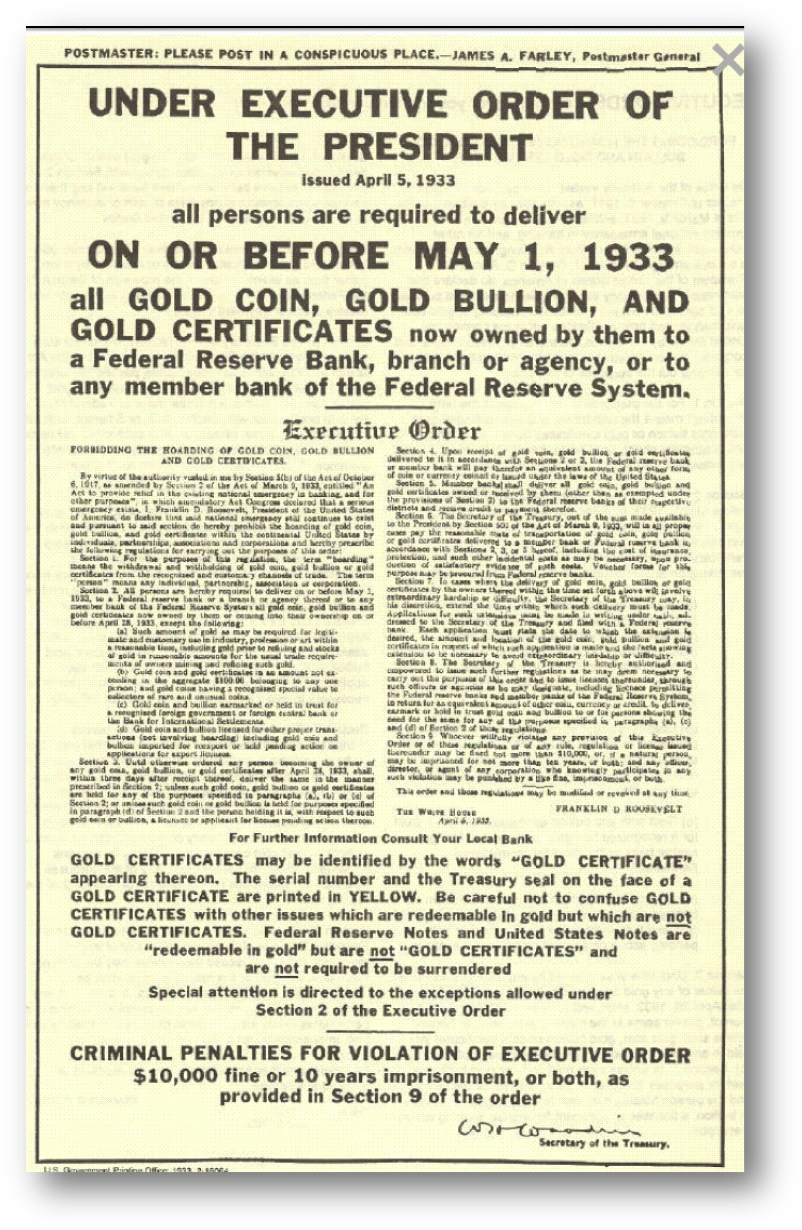 Click HERE to read the order in it’s entirety
At that stage, two major developments followed. First, the Great Depression began affecting the country in 1929. In response to numerous bank failures, people started hoarding gold.
Franklin Delano Roosevelt was then elected president. Concerned about bank runs as people hurried to trade paper money for gold, Roosevelt prevented banks from paying out or exporting gold.
Later, on April 5, 1933, the president announced that U.S. citizens had to surrender gold coins and gold certificates exceeding $100 in exchange for paper money by May 1 that year. When the order was issued, gold was priced at $20.67 per ounce. By 1934, the government set gold at $35 per ounce, effectively debasing the dollar by 75%.
At publication, That price, together with remnants of the gold bullion standard, remained in place until 1971. President Richard Nixon then closed the gold window, breaking the connection between the dollar and gold. This stopped foreign central banks from redeeming dollars for gold. Although the nation technically remained under the gold standard from 1933 through 1971, the Federal Reserve accepted only international dollar-to-gold exchanges.
The United States was the final country to remain on the gold standard. When this article was originally published, no country had currencies issued in terms redeemable for physical gold.
Ford’s Brief Glimmer of Hope
The gold coin standard did not return, but an event during President Ford’s administration changed the circumstances somewhat. As described earlier, Roosevelt had prohibited individuals in 1933 from owning, purchasing, or selling gold.
At publication, In 1974, however, Ford signed legislation permitting people once more to buy, sell, and possess physical gold. From 1974 through this article’s original publication, the public had invested billions of dollars in gold coins and bullion. Paper money still could not be exchanged for gold except privately, but millions of Americans valued and understood the importance of gold.
Trump’s Interest in Gold
The original article characterized former President Donald Trump as supportive of a gold standard. It noted that he had previously said returning to a gold standard was a strong idea. Along with those favorable comments, the article cited several actions over the years as support for that view.
The original article reported that Trump accepted three kilo gold bars from APMEX as a security deposit for space leased at one of his properties in 2011. In gold terms, that was roughly 96.5 ounces. Gold was then approximately $1,800 per ounce, translating to $174,000 for the three bars. The article presented this as a notable decision reflecting recognition of gold’s value.

At publication, During his presidency, Trump nominated Judy Shelton to the Federal Reserve Board of Governors in 2020. Shelton supported the gold standard openly. The Senate blocked her nomination, so the original article’s hoped-for addition of pro-gold-standard members to the Federal Reserve did not occur.
Summary
When originally published, the article stated that people could enjoy collecting gold coins or adding gold bullion to investments. It said Atlanta Gold & Coin Buyers made buying or selling gold simple and affordable.
At the time of publication, Atlanta Gold & Coin stated that it offered popular gold coins and bars at highly competitive industry prices. The original article also said it bought gold at fair prices and explained its pricing methods transparently.
At the time of publication, readers were invited to consult Atlanta Gold & Coin’s gold coin dealers for perspectives on collecting or investing in gold. The original article invited readers to contact the business to request an appointment, or learn how gold coins could help preserve wealth.