
Choosing the Best Silver Investment for Your Individual Needs and Circumstances
Before Amazon and Google reviews became commonplace, many people relied on Consumer Reports as a trusted source of information. At the time this article was published, consumers commonly turned to Google Reviews to investigate businesses before ordering meals, shopping, or considering silver and other precious-metals investments.
Those were the good old days, weren’t they?
At publication, the original author recalled growing up with Consumer Reports as a guide for major appliance and equipment  purchases, since the aim was always to find the strongest option within a set budget. Years later, Amazon and other third-party sources had become a “go-to” for reviews presented as unbiased. Even so, the original author said Consumer Reports ratings still deserved consideration whenever they were available.
That habit, like the one many readers shared, came from wanting dependable quality without paying more than necessary. Still, the word “best” is inherently subjective; what qualifies as best for one person may not fit another person’s circumstances.
Amazon itself separated its “best” and “top” ratings into several categories. The original article viewed that as notable: even the world’s largest company recognized that people differ and that a single answer cannot serve everyone.
As a veteran coin dealer, Atlanta Gold & Coin received daily calls from people new to precious metals at the time of publication. They regularly asked which gold or silver coins and bullion to buy, or which choices were “best” within their budget.
Most people, as expected, were surprised by Atlanta Gold & Coin’s response: “it depends.” The point was that every person IS different, with distinct needs, goals, and timelines.
That response resembled the kind of answer a financial advisor or wealth manager might have provided. Since every investment portfolio differs, the article explained, it should not be surprising that silver as an investment can suit different people in different ways.
Atlanta Gold & Coin recognized that becoming a new silver investor could feel overwhelming, particularly with the seemingly endless online resources and videos. The original article also noted that Atlanta Gold & Coin had once been new to metals investing.
With that in mind, Atlanta Gold & Coin’s stated goal was to make the process easier to understand and offer guidance to each client. The article did this by describing five buyer types believed to reflect the needs and preferences of most callers.
Because Consumer Reports opened the discussion, the original article used a similar framework for its suggestions within each silver-buyer category. It was intended to help readers recognize a category that fit them and to support their research into adding physical silver coins or bullion to their holdings.
The Budget-Focused Investor
At the time of publication, approximately 10% – 20% of callers sought the “cheapest silver” option possible. There were, of course, several inexpensive ways to obtain silver, including silverware or flatware sets, scrap jewelry, and recycled electronic equipment.
Although each of those methods could provide a lower-cost way to acquire silver, the resale market was not necessarily as broad when it came time to sell. For that reason, the original article advised readers to avoid treating those alternative forms as silver investments.
Recognizable silver could also be acquired inexpensively, according to the original article. Many callers knew that U.S. dimes, quarters, and half dollars dated 1964 and earlier contain 90% silver. Far fewer, however, realized that the U.S. Mint continued making half dollars with 40% silver content through 1970.
Another point the article highlighted was that certain U.S. nickels contain silver. Nickel was needed for World War II armor plating, creating this unusual exception. Congress therefore directed its removal in October 1942, changing the coins’ composition to 35% silver, 56% copper, and 9% manganese. The 1942 pieces bearing a mintmark above Monticello, shown on the coin’s reverse, are 35% silver. Every nickel dated 1943 – 1945 is 35% silver.
Known as war nickels, these coins often develop a darker patina than nickel-copper examples, which can make them somewhat easier to identify.
The article also identified 80% Canadian silver dimes and quarters dated 1966 and earlier, along with half dollars and silver dollars dated 1967, as an economical option. They were generally traded in bulk, much like 40% halves and war nickels. Canadian dimes, quarters, and half dollars generally traded for less per ounce than silver dollars. The original article added that
when this article was originally published, Queen Elizabeth II recently passed. As a result, these coins had become unusually popular because the queen’s portrait appears on their obverse. The article anticipated that demand would ease by the time readers saw it and that availability would return to normal.

Additional lower-cost choices mentioned were formerly circulating Mexican and British silver coins. Examples included Mexican pieces from the 1950’s or earlier, as well as British coins struck in the 1940’s and earlier.
Top Pick – 40% silver halves
Runner Up – 35% silver war nickels
Honorable Mention – 80% Canadian silver coins
The Inflation-Hedge Investor
The original article described a hedge against inflation as perhaps the most frequent reason clients sought physical silver. These buyers were concerned about the dollar’s future strength or viability, a financial or economic-market collapse, and/or hyperinflation.
 When this article was originally published, the inflation rate stood at 8.3%. It had reached a high in June 2022 of 9%. With food and energy prices rising, apart from gas, and supply-chain problems continuing, the reported consensus was that inflation would remain stubbornly elevated for the foreseeable future. The concern expressed was that it could accelerate beyond control over coming months and years.
At publication, The article raised another long-term concern about the dollar: Saudi Arabia was reportedly considering, or beginning, acceptance of currencies besides the dollar for oil. Up to that point, the dollar’s reserve-currency role had partly rested on the petrodollar. In practical terms, Saudi Arabia had required payment for oil in dollars, leading other nations to maintain substantial dollar reserves or exchange their local currencies for dollars when purchasing oil.
These individuals buying silver as an inflation hedge aren’t necessarily concerned about trading or bartering with silver. Their objective was simply to preserve purchasing power. At publication, Atlanta Gold & Coin had observed increased interest from retirees on fixed incomes trying to keep up with inflation. Inflation-hedge buyers generally were not selective about silver type, provided it was pure at .999 fine.
For people interested in pure silver, the article noted several choices. It described privately issued silver bullion as the least expensive route. Bullion appeared in many shapes and sizes, although rounds and bars were the most common forms. Among rounds, 1 oz sizes were the most popular. Bars ranged from a gram to 1,000 ounces, with 1 oz, 10 oz, kilo, and 100 oz sizes identified as the most common.
Buyers seeking a moderate quantity of silver often chose the 1 oz and 10 oz sizes. Those making a larger investment tended toward bigger bars, including kilo (32.15 oz) and 100 oz silver bars. As the article explained, larger sizes usually carried lower premiums. It also cautioned that name-brand bars—such as Royal Canadian Mint, Johnson Matthey, and Engelhard—and rounds often had higher premiums, so readers were invited at publication to research and compare prices before a first purchase.
Top Pick – 1 oz silver bars & rounds
Runner Up – 10 oz silver bars
Honorable Mention – 100 oz silver bars (great for stacking)
The Barter-Focused Prepper Investor
The original article said that worsening financial and geopolitical conditions had led more people to question the dollar’s long-term viability. Unlike people concerned principally with inflation, those acquiring silver for barter expected a complete failure of the dollar and of the banking or financial system.
Some people also worried about an EMP attack and prepared for what the article called a Mad Max scenario. It explained that an EMP, or Electromagnetic Pulse, could be created by weapons or, naturally, by a solar flare from the sun. For readers who had not heard about the Carrington Event, it is worth taking a quick look into our sun’s potential.
Such people are often described as preppers or survivalists.
The article acknowledged that silver for barter would not necessarily require a complete social breakdown. It cited Venezuela, where, at the time of publication, hard assets including gold and silver were among the only payment forms being accepted as the Venezuelan bolivar was rapidly approaching zero.
At publication, A point the article said many people missed was that currencies in use were fiat currencies. In other words, they were not backed by a commodity such as gold or silver and retained value only while the public had confidence in them. The article noted that lost confidence could quickly make a currency worthless, as had occurred more than once in Zimbabwe.
People obtaining silver for barter purposes often prefer coins or bullion in several sizes and denominations for a worst-case situation, because many people may be unable to make change. For instance, someone would not want to spend a 1 oz gold coin for a loaf of bread while hoping the seller could provide change. Smaller-denomination silver coins, along with small silver bars or rounds, seemed more sensible for transactions of that size.
As noted earlier, silver bars can be made as small as one gram, although bars in that size are uncommon and carry a substantial premium compared with their silver content. A more cost-effective way to acquire smaller denomination silver is by purchasing 90% U.S. silver dimes, quarters and half dollars issued in 1964 and earlier. These coins are readily recognized as silver by checking their date and the color along the edge. A coin with an unbroken silver-colored stripe is likely 90% silver.
Besides being available in smaller denominations, these coins are U.S. legal tender. They were also likely to be identified as silver coins by more people than several of the other alternatives discussed earlier in the original article.
In a practical barter example, a silver dime might cover a loaf of bread, a quarter a gallon of gas, and a half dollar a meal. Different denominations could also be combined or separated to address whatever financial need arose.
Top Pick – 90% silver dimes (most versatile)
Runner Up – 90% silver half dollars (most popular)
Honorable Mention – 90% silver quarters
The Portfolio Diversification Investor
Silver has several uses, including including as a hedge against inflation and bartering purposes; investment was another common use discussed in the original article. At the time of publication, many financial planners and wealth managers reportedly recommended that clients keep a 10% – 20% allocation to precious metals because of their low correlation with other asset classes. The article explained that this could reduce portfolio volatility and improve returns.
The original article did not offer general investment advice, but said that comparing investment choices generally involves considering their valuations before selecting one. At the time it was written, the article characterized the stock, bond, and real-estate markets as appearing to be in a bubble.
When this article was originally published, cryptocurrencies had become much more popular in recent years, but were described as extremely volatile and prone to major corrections. The article said people uncomfortable with sharp volatility might find cryptocurrencies unsuitable. It further noted that many coins from the Mt. Gox (a bitcoin exchange that handled roughly 70% of all bitcoin transactions) bankruptcy in 2014 have been recently recovered, which could flood the market with Bitcoin and could push prices down further.
At the time of publication, silver was reported as trading near $20, while its mining price was said to be not far from production cost. On that basis, the original article viewed silver as having limited downside risk and considerable upside potential. It acknowledged that the low might not yet have occurred, but suggested prices could not remain below production costs for long.
The article observed that few investments allow an item to be acquired close to what it costs to produce, which it presented as making silver an appealing investment possibility.
For investment purposes, the original article identified one-ounce government-issued coins as the most popular silver format. These coins were commonly sold in tubes containing 20 or 25 coins.
Among investors, the original article identified 1 oz American Silver Eagles, Canadian Silver Maple Leafs, British Silver Britannias, Austrian Silver Philharmonics, and Australian Silver Kangaroos as popular choices. It noted that all had been produced for decades, with hundreds of millions made collectively. Their broad worldwide recognition and popularity were presented as factors making them highly liquid when owners later chose to sell.
At the time of publication, American Silver Eagle premiums were reported to be noticeably higher than those of the other coins because of supply and demand. Demand was described as nearly unprecedented, while supply remained limited by supply-chain problems and shortages of silver planchets used for striking coins. The original article also reported late-September rumors 2022 that the U.S. Mint might pause Silver Eagle sales, potentially raising premiums temporarily further.
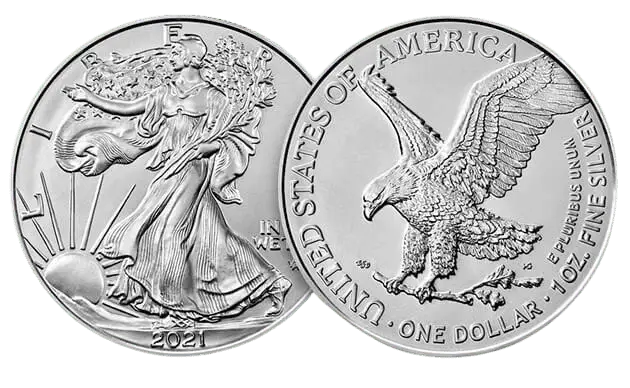
Top Pick – American silver eagles (even though premiums are elevated)
Runner Up – Canadian silver maples (our neighbor to the north)
Honorable Mention – Austrian silver philharmonics, British silver britannias, Australian silver kangaroos
The Silver Coin Collector
The final category highlighted in the original article was the silver coin collector. In certain ways, it included many of the investor types described above, with the possible exception of the barter investor. Coin collectors are interested in coins that have collectible or numismatic value and place greater emphasis on a coin’s visual appeal, grade, historical importance, and rarity.
Although investment can matter, collectors tend to focus more on finding scarce or difficult-to-locate pieces. They may also pursue a defined collecting objective, such as building a complete set of Morgan silver dollars.
When this article was published, Morgan silver dollars were described as probably the most collectible silver coins on the market. A total of 650 million coins were minted from 1878 – 1921, but many were unfortunately melted under the Pittman Act. As a result, fewer than 650 million coins were said to exist.
These coins involve details beyond what is immediately visible, which was why Atlanta Gold & Coin had previously devoted substantial time addressing these coins from different perspectives.
Collectors also commonly gravitate toward the Peace silver dollar. Produced after Morgan silver dollars, these coins had a limited production span of only 10 years. The Philadelphia, Denver, and San Francisco Mints produced 24 different coins from 1921 – 1928, and again in 1934 and 1935. That comparatively brief run explains why fewer are available than Morgan silver dollars.
Morgan silver dollars were, in fact, produced at nearly 3.4 times the rate of Peace dollars. In Atlanta Gold & Coin’s most recent Peace-dollar article at the time of publication, six coins were identified as common when circulated but key-date or valuable when uncirculated.
Another widely sought and attainable coin for collectors is proof silver eagles. The U.S. Mint introduced these coins in 1986 and, as of the article’s publication, had made them annually except in 2009. At that time, many precious-metals buyers purchased proof Silver Eagles to add to their silver holdings.
These coins were issued directly by the Mint in attractive packaging that included a velvet case, COA, and outer box. They were also widely available in certified condition, but IRA eligibility required original government packaging (OGP). For that reason, many collectors preferred to collect them raw, or ungraded.
The original article then presented its historical selections for collectible silver coins, a result unlikely to surprise its readers:
Top Pick – Morgan silver dollars (the cornerstone of most collections)
Runner Up – Peace silver dollars (an impressive and valuable coin in its own right)
Honorable Mention – Proof silver eagles (limited edition varieties also exist)
Summary
The original article discussed many “best” choices, depending on which category best described a person and suited that person’s objectives. Its point was that no single option fits everyone, so it said a conversation was needed before particular items could be recommended.
To summarize, the original discussion began with lower-priced silver coins: U.S. and foreign coins once used in ordinary circulation, with purity below 90%. These coins generally traded at modest premiums above their melt value or silver weight. The article advised readers at publication to avoid alternative silver forms and attempting to melt silver themselves.
The article next considered silver as a possible inflation hedge, especially silver bullion. Based on the amount of silver a reader was considering acquiring at publication, it suggested 1 oz, 100 oz, or a size between those options.
At the time of publication, premiums per ounce were typically somewhat lower for kilo-sized bars and larger. The 1,000 oz silver bars had the lowest premiums, but were more institutional in grade and could be harder to sell later.
At publication, The idea of using silver for bartering purposes had once been a fringe outlook, but in the years before publication Atlanta Gold & Coin had spoken with and met many clients interested in acquiring silver for that purpose. In general, the article stated, 90% U.S. coins, including silver dimes, quarters and half dollars are best used as a medium of exchange.
At publication, many callers and clients were interested in silver as an investment because of its perceived upside potential and low correlation with other investments. The article also noted that financial advisors recommended precious metals for diversifying portfolios composed of traditional asset classes.
For investment use, the original article called the American Silver Eagle the most popular coin, while also noting that other suitable choices had been discussed.
Finally, at the time of publication, coin collectors represented a meaningful share of Atlanta Gold & Coin’s customer base.
When this article was originally published, collectors had many coin choices to consider, such as Morgan silver dollars, Peace silver dollars, and proof American silver eagles, among others. The original article noted that Morgan and Peace silver dollars could be priced from the low double digits into the thousands of dollars, so anyone considering collecting or investing in them was encouraged to learn about the coins first.
When this article was originally published, Atlanta Gold & Coin Buyers expressed hope that readers found the information useful and invited them to make contact regardless of their needs, goals, or circumstances.
At the time of publication, Atlanta Gold & Coin stated that it assisted all types of silver buyers and can offer items and offered recommendations about items suited to their needs. The original article also invited readers to use Give us a call today for help with a first or 1,000th silver or other precious-metals investment.
The original article closed: Happy treasure hunting.
At publication, readers were invited to call at 678-515-5763!

