
Inherited a Coin Collection: Keep It or Sell It? 5 Points to Consider
Over the years before this article was published, Atlanta Gold & Coin had encountered this situation hundreds of times. A family member had died, leaving behind a coin collection. Many heirs had little or no coin experience. Naturally, the collector’s interest in the coins could suggest there was a particular reason they had valued and accumulated them.
Were the coins acquired as a hobby, or as an investment? An heir might have had no personal interest in the collection and could have felt guilty about that lack of interest. When this article was originally published, it was written to help address those understandable questions and decisions.
This article outlines several considerations, including some readers may not have previously considered, when deciding whether to keep or sell an inherited coin collection.
Coin Interest and Knowledge
In many cases, heirs Atlanta Gold & Coin met did not share their father’s or grandfather’s enthusiasm for coins. People have different interests from their relatives, which is entirely normal. Some may have had ample free time and wanted a new hobby, while others could not reasonably fit one more commitment into an already full life.
Atlanta Gold & Coin’s experience was that an heir’s level of interest was among the most important factors in deciding whether a coin collection should be kept or sold.
Alternatively, an heir may have gone with a father or grandfather to coin shows or a local coin shop and developed more than a casual familiarity with coins. Based on the coins collected or invested in, valuing the collection might be straightforward, particularly where purchases were mainly bullion or bullion coins.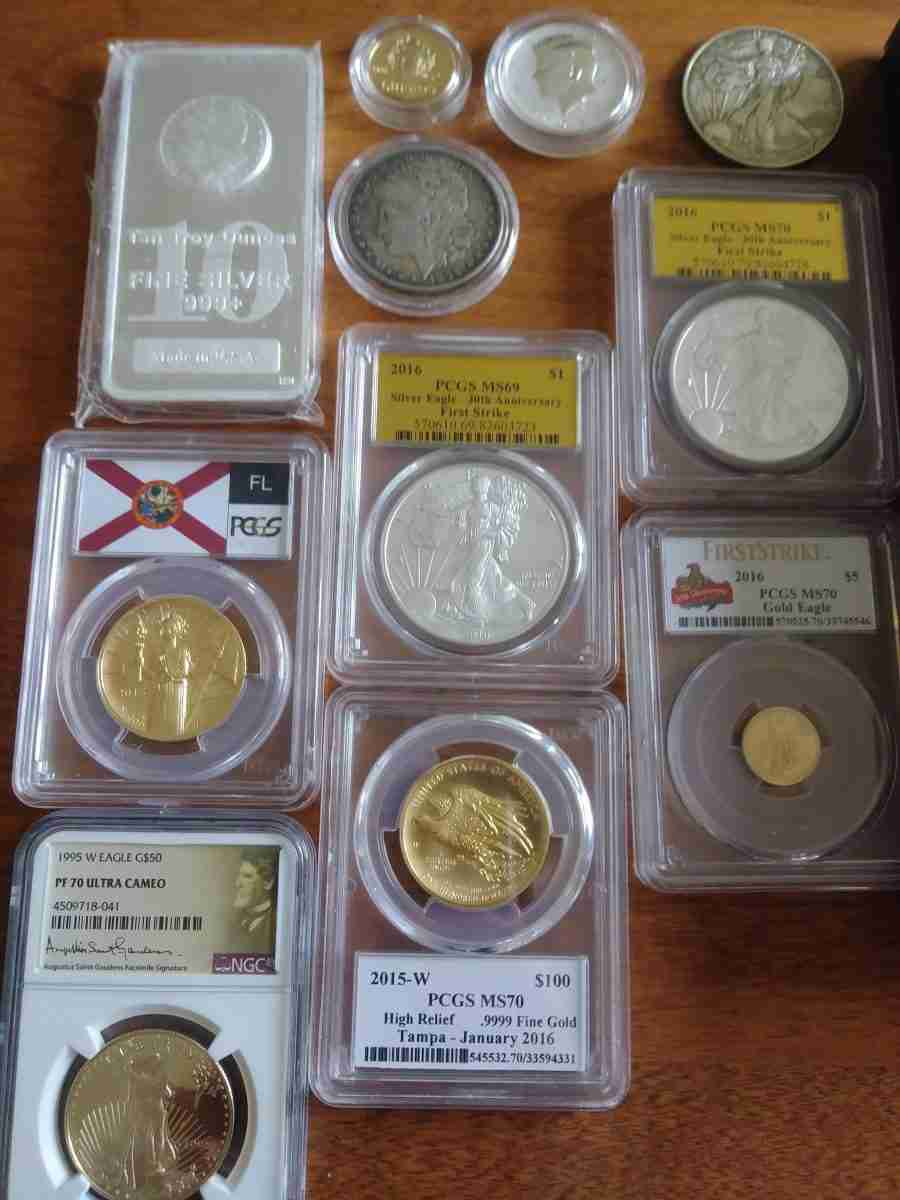
If the collection emphasized numismatic or rare coins, identifying the market and values that were current when this article was published could have been more difficult.
At the time of original publication, the article described the following: Both considerations—interest and knowledge—matter. If an heir had recently retired at the article’s publication, had considerable spare time, or wanted a new hobby, keeping the collection might have made sense.
Likewise, familiarity with coins, confidence in identifying the pieces, and comfort evaluating their worth could have supported keeping a collection. But for someone seeking to simplify life, with little interest in coins and limited industry knowledge, selling the collection may have been the more suitable option.
Collecting and investing in coins can be enjoyable and rewarding. The original article also offered a caution to new collectors and investors: internet information should not automatically be accepted, and research should rely on dependable sources.
It is also worth remembering that a seller can ask any price for a coin. What matters is the market and what another person will pay. At the time of publication, the article advised caution when using YouTube, TikTok, eBay, and Etsy as sources for coin values, describing them as unreliable for that purpose.
Expected Future Growth & ReturnsAt the time of original publication, the article described the following:
Before this article was published, customers often asked Atlanta Gold & Coin about the coin and bullion market, increases in recent years, and expected future returns. No one has a crystal ball for price direction, but the original article could offer some perspective on where prices had been.
Historically, gold and silver prices have risen with the price of inflation. This was not always true, but the article used the example that a $20 gold piece from the 1920’s could purchase the same quality suit and shoes it could purchase at publication. Put another way, the $20 gold coin was worth more than face value. Silver could work similarly.
By contrast, collectible and numismatic coins tend to follow collectors’ changing interests, along with an item’s scarcity and demand. For example, the 1995-w proof silver eagle certified PR70 by PCGS reached an all-time high of $86,655 in March of 2013. At the time of publication, the original article reported that the same coin could be obtained for under $20,000.
The article attributed that change to more coins being certified as proof 70, a figure that, at the time this article was written, was 458.
The collectible and numismatic market can also be influenced by economic strength and discretionary income. As the original article noted, collectibles may not perform as well in a weak economy. Sports fans are sometimes called “fair weather fans” when their team struggles and they abandon it.
The rare-coin market can behave similarly: coins that were popular only months earlier may have had little or no market at the time of publication. 
At the time of original publication, the article described the following: In that type of market, the original article emphasized understanding demand for a specific item, its value compared with historical prices, and changing market conditions. Without that context, an owner could be caught flat-footed. For the 1995-w proof silver eagle discussed above, a buy-and-hold approach would have been expensive.
With all of that said, future growth and returns for gold, silver, and rare coins remained anyone’s guess when this article was published. Atlanta Gold & Coin hoped the market would continue performing well, but the article made clear that life offers no guarantees.
The original article also suggested that a recession would likely reduce interest in rare or numismatic coins. Historically, it added, a stronger dollar has typically been bearish for gold and silver prices, which have tended to move in opposite directions.
Conversely, a weaker currency has typically been bullish for precious metals. At publication, the article said that much of the decision came down to where an individual believed the economy was heading.
Other Investment Options
At the time of publication, investment opportunities were described as nearly unlimited. Historically, stocks, bonds, and real estate had been the three principal choices. The article observed that people could then invest in almost anything.
Vintage wine, classic automobiles, luxury watches, and handbags were presented as popular alternative investments. At publication, the article reported that one Atlanta Gold & Coin customer invested in Scotch whisky.
The original article reported another customer’s investment in fine wine. Atlanta Gold & Coin added that high-end tequila would be tempting, although the temptation to drink the investment made that unsuitable.
Some people are dedicated investors, while others have only a passing interest in investing. Familiarity and experience with different options, along with the state of those markets when this article was published, could help determine whether those markets suited someone better than coins.
Over the several years preceding publication, Atlanta Gold & Coin customers had shown strong interest in Bitcoin and the crypto currency market generally. The article reported increased coin activity when the crypto market was down, as investors sold coins to pursue discounted prices in that market.
At the time of original publication, the article described the following: The article characterized this as an interesting alternative investment that had become more popular in the recent years before publication, largely because financial networks and alternative media sites had given it substantial coverage.
Other possibilities included starting a business, funding an existing business, investing in a startup, supporting projects of personal interest, or simply placing money in a savings account.
Some individuals take a more conservative approach, placing funds in a savings account or CD and waiting for investment opportunities to arise.
Whatever direction someone chose, the original article said it was sensible to weigh other possible investments. If a person felt funds were best kept in coins or bullion, the article indicated that choice could be appropriate.
A Probate Estate: What Happens to the Coin Collection?
In many situations, an estate was in probate and a judge had frozen assets connected with it. Before publication, Atlanta Gold & Coin frequently met people in this frustrating position, often with an immediate need for funds to pay funeral costs, executor expenses, and attorney fees.
In some circumstances, a coin collection formed part of the estate; in other circumstances, it did not.
If the collection was not part of the estate, it could be sold to cover those expenses. The original article reported a recent meeting with a man selling his mother’s coin collection because his father had recently died and the court had barred sale of estate assets.
The article reported that her expenses were substantial, but that proceeds from selling the coin collection were enough to support her through probate until the estate could be liquidated.
Unfortunately, the original article described this as a situation that was not unusual. Atlanta Gold & Coin had frequently met customers facing similar circumstances. In many cases, selling a coin collection was necessary to bridge the gap before access to estate assets became possible. For readers in that situation at publication, a collection outside the estate may have been one way to cover near-term expenses.
Multiple Heirs to a Coin Collection
Whenever an estate involved more than one heir, the original article noted a greater possibility of complications. In many cases, a will set out the deceased person’s wishes for a coin collection, though that was not universal. When no directions were provided and several heirs were involved, differing views about how the collection should be handled became more likely.
When several heirs were involved, the article described liquidation of the coin collection and distribution of the proceeds as the usual practical approach. If someone wished to retain part of it, an itemized appraisal could help the heirs divide the collection fairly.
At the time of publication, Atlanta Gold & Coin had evaluated a substantial collection that heirs allocated using an itemized appraisal. The heirs who chose to sell their shares sold them to the company, while those who preferred to retain their shares were able to keep them.
At the time of original publication, the article described the following: A further option for estates with multiple heirs was to obtain an appraisal and let one heir purchase the others’ interests. The article explained that this was generally workable when a coin collection was worth less than $10,000. It also noted that Atlanta Gold & Coin had evaluated estate collections over the years ranging from $50,000 – $250,000 or more, making that arrangement less practical for many families.
If retaining the coin collection within the family was the goal, a fellow heir could pay the appraised value for another heir’s share. The original article said this arrangement was heard about frequently.
As another approach, an heir interested in retaining the collection and purchasing the other heirs’ shares was invited, at the time of publication, to seek a formal appraisal from a company such as Atlanta Gold & Coin Buyers.
Conclusion
In closing, this article reviewed several circumstances relevant to deciding whether an inherited coin collection should be kept or sold. It encouraged readers to assess their own situation honestly and decide objectively whether retaining the collection made sense. Someone seeking a new hobby, or someone with previous experience with coins, might have elected to keep it.
The original article also recommended researching the historical performance of any coins or bullion in the collection. After gaining a clearer understanding of the items involved, readers were encouraged to compare that information with other investment opportunities that were available to them at publication. Coin investing and collecting can be an enjoyable hobby, but it does not suit everyone.
Probate and the presence of multiple estate heirs were additional considerations. If the coin collection was treated as estate property, court approval might have been required before it could be sold. If it was not, the article noted that it could provide a useful way to cover funeral expenses, probate court costs, legal fees, and living expenses.
For estates involving multiple heirs, the article outlined several possible paths. They included selling the coin collection and dividing the proceeds, obtaining an appraisal and distributing the individual coins, or allowing one heir to purchase the interests of the other heirs.
The original article expressed hope that its discussion of inherited coin collections had been useful and, at publication, invited readers to contact Atlanta Gold & Coin Buyers for assistance.
At the time of publication, Atlanta Gold & Coin stated that it specialized in large estate coin collections and had purchased thousands over the years, presenting this as a reason readers might choose the company.
At the time of original publication, the article described the following: At publication, readers were invited to call that day at 678-922-4909!

