


 Hunter Rhodes
The Remarkable Stories Behind Well-Known Gold Coin Hoards
The best-known gold coin hoards often have the most compelling stories behind them. People who imagine making a discovery like this can enjoy the excitement secondhand by hearing the account and passing it along. When this article was originally published, people years ahead might uncover caches of then-current Gold American Eagles, though the famous gold hoards described then involved older coins and gold objects. In the 1800s and early 1900s, gold coins served a purpose very different from their use when this article was published. They functioned as everyday money in ordinary transactions. That history explains why U.S. Mint gold coins still carry a denomination, including the $50 American Gold Eagle. At the time of publication, buyers acquired gold coins and other gold forms for investment and collecting purposes, rather than for routine daily payments. Every hoard discussed here includes rare coins that excited—and, when this article was originally published, still excited—collectors when they were offered publicly for purchase. For readers seeking other hoards containing silver coins, especially U.S.-minted Morgan Silver Dollars, the original article directed them to check this article out! Below are several especially famous hoards, along with how each began and how it was ultimately discovered.Granite Lady Gold Coin HoardAt publication,
The Old Granite Lady was the nickname for San Francisco’s large granite Mint building, which is now a historic landmark. It was that city’s second mint; the first had been established in 1852 in response to the California Gold Rush. This hoard contained gold and silver coins that may have been worth millions of dollars. Its gold pieces included older $20 Gold Double Eagles dated from 1850 through 1866. These coins plainly carried both intrinsic value and considerable numismatic value. The $20 Double Eagles from this period were Liberty Head issues. Each coin weighed 33.43 grams and contained a total gold weight of 0.9675 ounces. At almost 1 troy ounce, these substantial pieces ranked among the heaviest gold coins the United States Mint regularly placed into circulation. This coin’s gold content is 90% gold.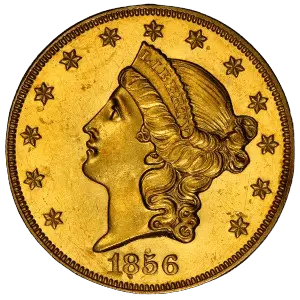
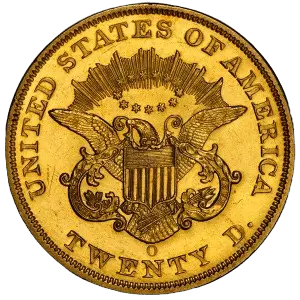 Across the dates 1850 - 1866, several scarcer $20 Double Eagles were issues the hoard was believed certain to contain. These scarce $20 Double Eagle gold coins include:
- 1854-O
- 1856-O
- 1861-S Paquet reverse - The Philadelphia Mint version of this Paquet reverse is notably a true landmark rarity
Saddle Ridge Hoard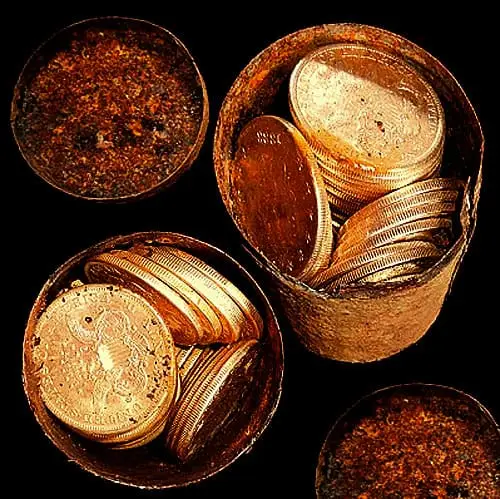
Tales of buried gold are woven through the culture that developed around the California Gold Rush. Banks were neither as stable nor as widespread as they were when this article was published, leaving people with less access to them or less confidence in them. As a result, many hid gold coins on their own land, believing that option was safest.
The Saddle Ridge Hoard was among the most notable gold coin hoards, found by the owners of property they called Saddle Ridge. The family often walked the land, but on one occasion noticed a rusty can on the ground. Using a stick, they pried it out of where it rested and realized that it was unexpectedly heavy.
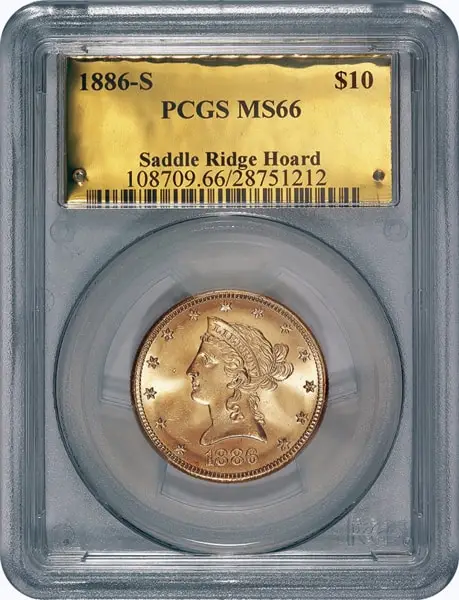 When the lid came loose, a gold coin appeared. They quickly learned the can was packed with gold coins, then later located seven more cans holding gold coins. Altogether, the discovery exceeded 1,400 rare gold coins!
The Saddle Ridge coins ranged in date from 1847-1894. Their types and face-value breakdown was presented as follows:
- $500 face value represented by $10 coins
- $27,460 face value represented in $20 coins
- $20 face value in $5 coins
Baltimore Find
Among gold coin-hoard discoveries, the Baltimore Find has a more tragic account. In 1934, two teenagers dug into their tenement floor to conceal something from their childhood club—perhaps cards or secret club rules. Their shovel suddenly struck a hard object, later identified as a $20 gold piece. They continued digging and ultimately uncovered two pots containing 3,558 gold coins dated in the 1830s, 1840s, and 1850s. Their face value was $11,200, although the original article stated that, at publication, the coins would be worth more than $10 million! Unfortunately, the account did not end with the teenagers becoming wealthy. The U.S. Gold Act of 1933 had only recently taken effect, and individuals were not legally permitted to own gold. Once they learned that, they understood they had no way to sell gold coins safely. As law-abiding citizens, the boys surrendered the gold to a police officer. The police department secured it in a vault and announced it would receive claims. A number of people did file claims asserting that the gold belonged to them. Eventually, the coins went to auction, with $6,000 reserved for each boy upon reaching 21. One boy, however, died from pneumonia before reaching his 21st birthday, and received nothing. What became of most of these coins is unknown. Still, the story has continued to capture the imagination of those who hear it.Wells Fargo Gold Coin Hoard
The Wells Fargo Hoard took its name from what may be the least significant part of its history. In 1917, its owner exchanged a substantial group of 1908 No Motto $20 Saint Gaudens Double Eagles while making an international payment. The coins remained hidden from 1917 until the 1960s, despite the early 1930s legal requirement that individuals surrender gold to the government. During the 1960s, they were put into replacement bags, only to be hidden away again afterward. In 1996, a precious-metals dealer obtained the hoard. For only a brief period after acquiring the gold coin hoard, the dealer kept it in a Wells Fargo Bank. That short storage period is the sole basis for the hoard’s name. When submitted for grading, the coins proved to include many exceptional examples. Thousands of coins earned MS66, while 101 coins earned MS68 and ten were graded MS69. Coins graded MS65 or higher are considered "Gem," making this an especially notable discovery. Although none received the coveted MS70 grade, one coin was selected and labeled “Wells Fargo – The Best One!”Sutton Hoo Burial Ship
One of the older gold coin hoards was found at the Sutton Hoo medieval cemetery. It may not be the largest hoard, but it is certainly an intriguing one. Just 37 gold coins were discovered in a burial ship in East Anglia. They were exceptionally old Anglo-Saxon coins, dating from sometime before the 7th century A.D. They were struck within the small Merovingian Frankish kingdom. Along with the 37 coins were three blank pieces shaped like coins and two gold ingots.
Norfolk Hoard
Continuing with East Anglia, another enormously important discovery emerged in that area. Called the Norfolk Hoard, the treasure was an internationally significant find. Remarkably, the metal detectorist who discovered it chose to stay anonymous. Even without his name being linked to it, news of the find became widely known. The anonymous finder recovered the first coin from the hoard in 1990. That discovery was only the start. More gold was found afterward, largely between 2014 and 2020. After hearing about this extraordinary discovery, a police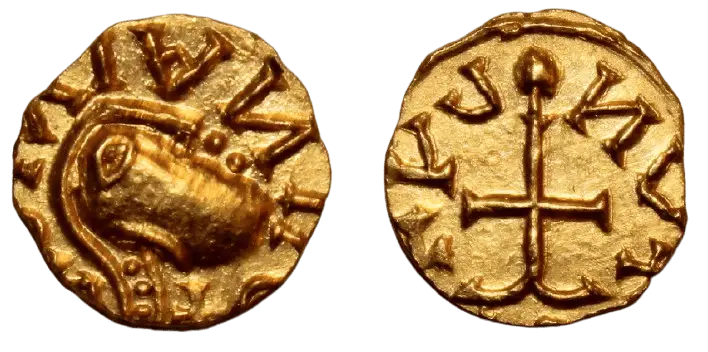 Frankish Tremissis
officer tried to take advantage by trying to represent coins found in that same field as parts of other discoveries.
After attempting to sell them, he was dismissed from the police department and received a prison sentence.
The Norfolk Hoard is the only gold coin hoard known to contain Frankish tremisses dated from 580 A.D. through 630 A.D. It also contains Roman gold solidi, a gold pendant, pieces of gold, a small gold bar, and gold objects that were likely jewelry.
At the time, most gold in this hoard was considered gold bullion, though it later carried substantial collector value.
The Norwich Castle Museum and Art Gallery sought to add the Norfolk Hoard to its collection. At the same time, the coroner began a case to determine whether the coins qualified as treasure. The criteria included being more than 300 years old and consisting of more than 10% precious metals.
Given that the 131 coins date from the Anglo-Saxon period and some gold objects are over 1,400 years old, it appeared quite likely that the required age criterion would be fulfilled.
Starting Your Own Gold Coin Collection
When this article was originally published, readers intrigued by gold coin hoards were invited to consider beginning a collection of their own. The article stated that gold coin specialists at Atlanta Gold & Coin Buyers could help people locate and acquire the gold coins they wanted, while also offering guidance on building a precious-metals portfolio. It also represented its pricing as fair and transparent, intended to help buyers receive the most from their investment. The original article also stated that people who found, wished to sell, or hoped to purchase a gold coin could receive assistance. Contact us At the time of publication, readers were invited to learn more about buying, selling, and collecting gold coins.
About the author
Hunter Rhodes
Owner & Managing Director, Atlanta Gold & Coin
Hunter joined Atlanta Gold & Coin in 2022 and purchased the company at the end of 2024. He has been investing in precious metals since 2010, with gold remaining his favorite metal. While he may never admit it, Hunter has a numismatic collector’s side, especially when it comes to select type coins. Libertads and Engelhard rounds are among his favorites.
Meet our team