U.S. Gold Coins Featuring American Presidents
When this article was originally published, Atlanta Gold & Coin customers often brought presidential coins to Atlanta Gold & Coin Buyers that appeared to be gold. In particular, this included the $1 Presidential Series Coins.
Many coins that look this way, however, are not made from solid gold. They are instead manganese pieces covered with gold plating. That distinction raises an important question: how can someone determine whether a coin in hand is actually gold?
Knowing which U.S. gold coins portray presidents can make identification easier. For collectors, the useful point is that only eight fit this description. Several are pre-1933 gold issues, while the rest are modern commemorative coins.
Since the modern commemorative program started in 1982, the United States Mint had raised over $506,301,189 through surcharges supporting the purposes assigned to the various coins. For instance, when this article was published, proceeds from National Parks Gold Coin sales went toward U.S. National Parks funds.
Readers interested in silver coins depicting U.S. presidents were, at the time of publication, directed to Atlanta Gold & Coin’s article about those pieces, HERE. This article continued with the 8 U.S.-minted gold coins portraying former presidents.
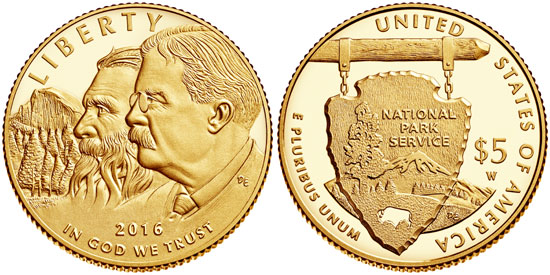
1. National Parks $5 Gold Coin – 2016-W
In 2016, the United States Mint honored the 100th anniversary of the National Park Service using a commemorative $5 gold coin. On the obverse, sculptor Don Everhart placed former President Theodore Roosevelt beside naturalist John Muir. The reverse carries the National Park Service logo.
Struck at the West Point Mint, these U.S. gold coins contain solid 90% fine gold. The authorized mintage across this limited gold program totaled 100,000. Their actual final mintage, though, was 5,150, a figure that made them relatively scarce coins.
Like purchasers of other commemorative issues, people who bought National Parks program gold coins at the time paid a surcharge. Those funds were passed along to support National Park Service programs.
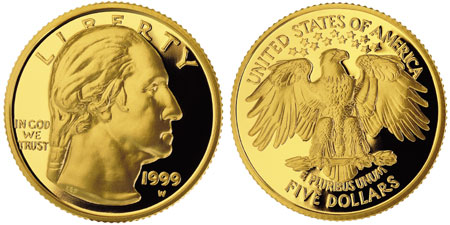
2. Washington $5 Gold Coin – 1999-WAt publication,
The history behind the George Washington $5 Gold Commemorative Coin is particularly notable. In 1932, during development of the Washington Quarter, the Treasury Secretary rejected artist Laura Garden Fraser’s design despite the Commission of Fine Arts preferring it. Researchers later found evidence that he rejected Fraser’s work because he did not want a woman to design the coin.
At publication, As for the coin, it was produced to commemorate the 200th anniversary of the first U.S. president’s death and contains .90 pure gold. Its obverse presents a right-facing portrait of President Washington, while its reverse shows an eagle surrounded by 13 stars.
The Mint received authorization to strike as many as 100,000 coins. Final production, however, reached only 22,511 uncirculated pieces and 41,693 proofs.
When the coin was originally offered, buyers could obtain these U.S. gold coins one at a time or in a set containing one proof and one uncirculated example.
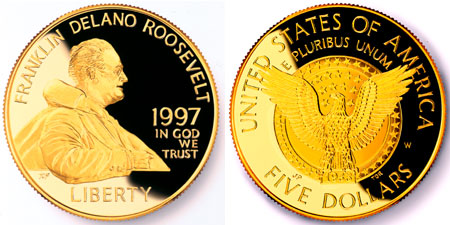
3. FDR $5 Gold Coin – 1997-W
The program responsible for the 1997 Franklin D. Roosevelt $5 U.S. gold coins was unusual: it consisted solely of $5 gold coins, with no additional denominations, medals, or silver issues. It depicts a U.S. president and is a solid-gold coin of 90% purity. Only 11,894 uncirculated and 29,474 proof examples were minted, making it a low-mintage, sought-after issue.
Its obverse is an unusual design by T. James Ferrell, depicting FDR reviewing the Navy fleet in San Francisco Bay. James Peed designed the reverse, using the Presidential seal displayed at FDR’s inauguration.
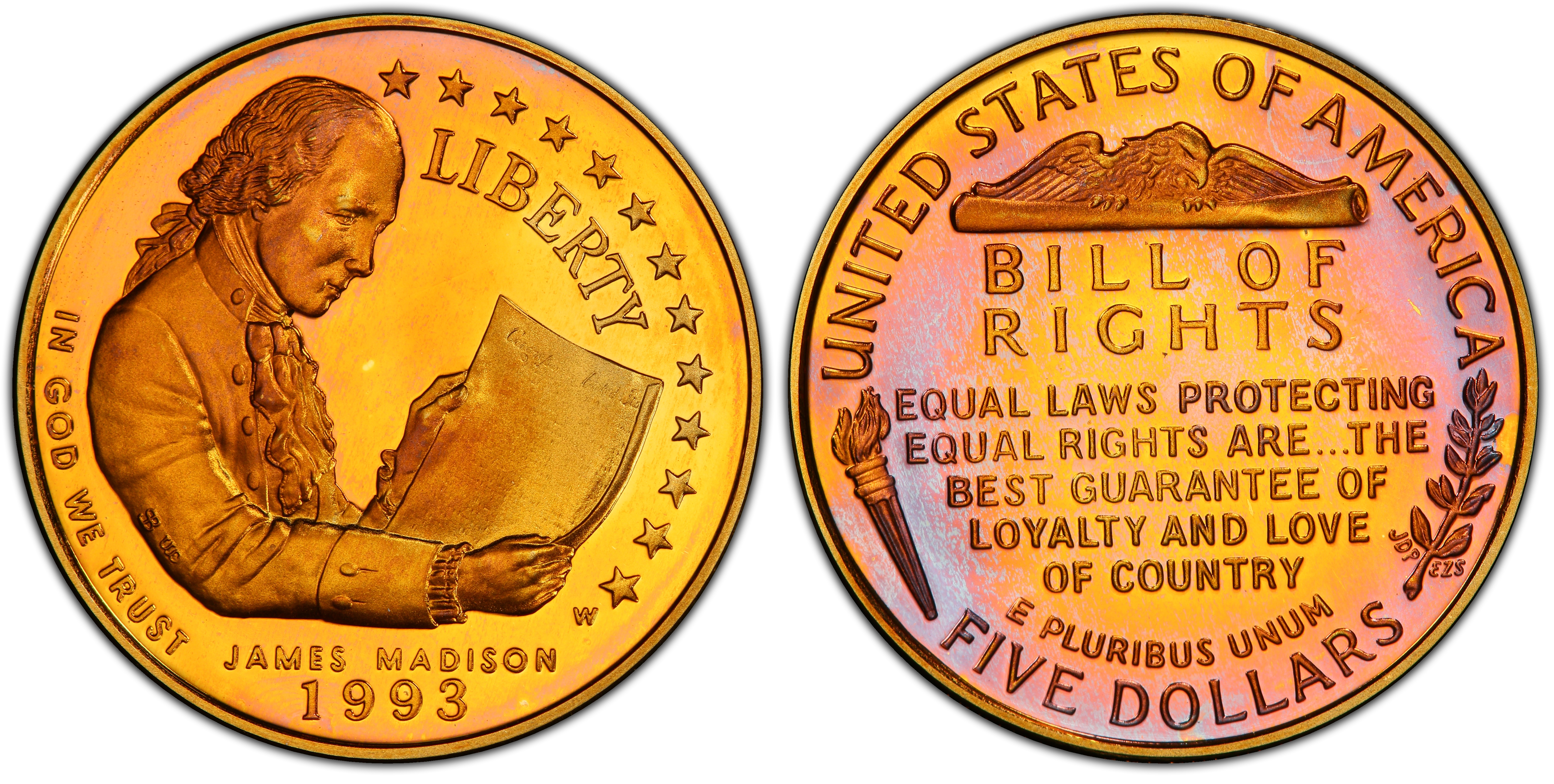
4. Bill of Rights $5 Gold Coin – 1993-W
The president shown on the obverse of the Bill of Rights $5 U.S. gold coins is James Madison. Shown roughly from the waist upward, Madison is reading the Bill of Rights. Scott R. Blazek created the obverse, and Joseph D. Pena designed the reverse.
The reverse also includes two distinctive inscriptions: “Bill of Rights” and “Equal Laws Protecting Equal Rights Are The Best Guarantee of Loyalty and Love of Country.” This $5 presidential issue is 90% pure gold throughout. The $5 proof U.S. gold coins had a mintage of 11,523.
5. Mount Rushmore $5 Gold Coin – 1991-W
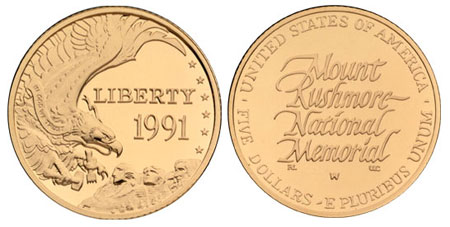
Another commemorative bearing a W mintmark, the Mount Rushmore $5 gold coins, released in 1991, marked the 50th anniversary of Mount Rushmore. The coin’s surcharges were divided between the Mount Rushmore National Memorial Society of Black Hills and the Federal Treasury; the Treasury was to apply its share toward reducing the national debt. It was struck entirely in .90 fine gold.
John Mercanti designed the Mount Rushmore obverse, naturally including the four presidents carved into the mountain: Washington, Jefferson, Lincoln, and Theodore Roosevelt. An eagle flying above the monument is more prominent on that side. Robert Lam created the reverse, which carries Mount Rushmore National Memorial as its principal inscription along with four standard inscriptions.
About 22,478 proof coins and 3,869 uncirculated examples of these U.S. gold coins were struck. The same program also produced 90% silver dollars and clad half-dollars.
6. $1 Louisiana Purchase – 1903
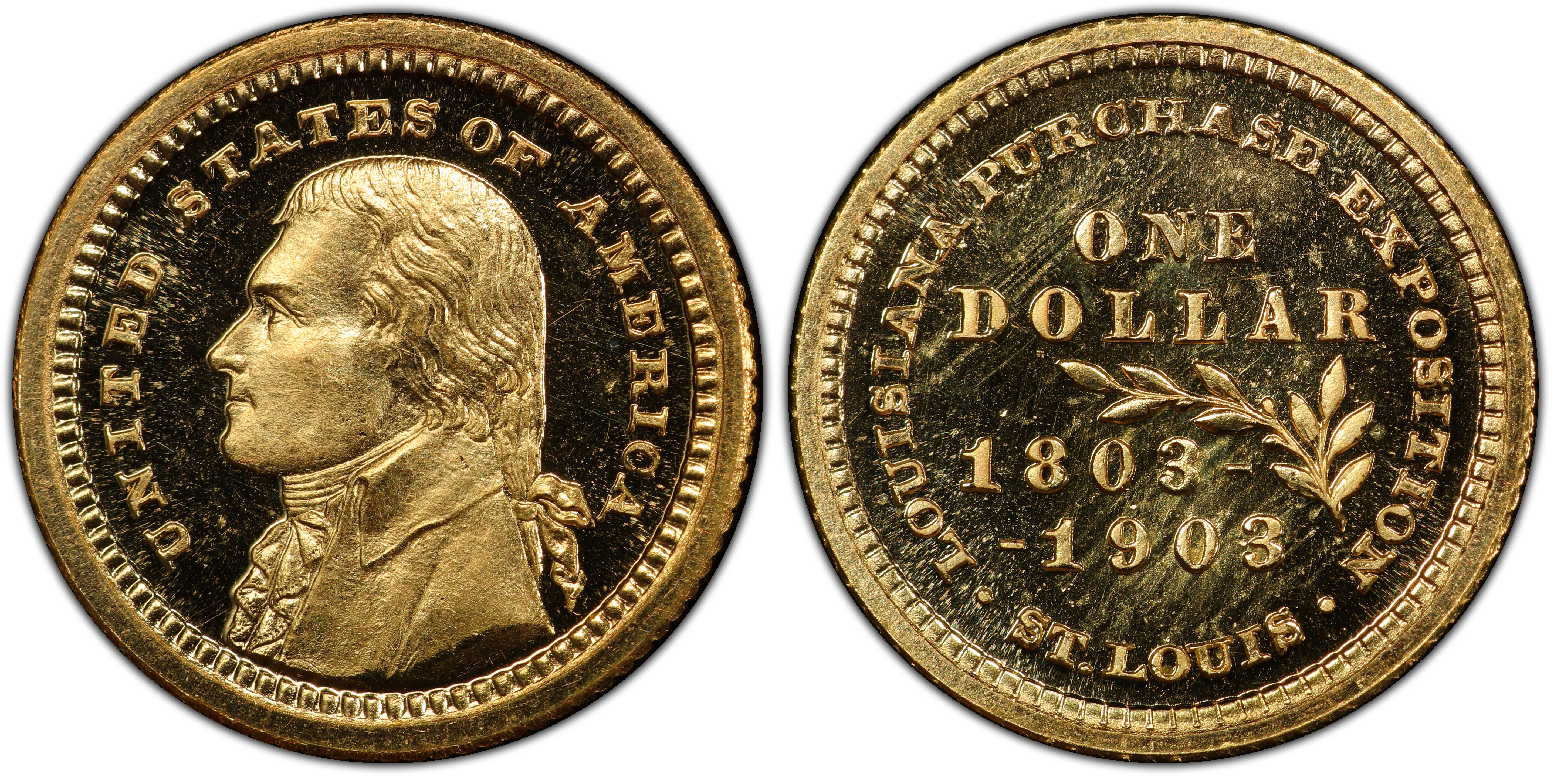
Philadelphia struck the $1 Louisiana Purchase U.S. gold coins for the 1903 World Fair. They observed the 100th anniversary of the Louisiana territory purchase. Each coin contains 90% gold and 10% copper. It is one of just three pre-1933 U.S. gold-coin designs that were minted.
During the design process, Farran Zerbe, then a prominent coin dealer, interestingly recommended that the Mint use two separate obverses. Consequently, half the coins portray Thomas Jefferson and the other half portray William McKinley. McKinley, incidentally, had no connection to the Louisiana Purchase itself.
He was selected only because he had been assassinated shortly after signing the bill that authorized the World Fair.
7. $1 McKinley Commemorative Gold Coin – 1916 & 1917
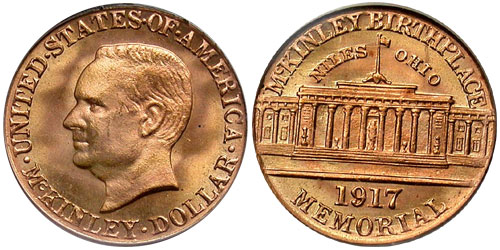
In 1916, fifteen years after former President William McKinley’s assassination, the Philadelphia Mint struck $1 gold coins in his honor. These 90% gold dollars show a left-facing McKinley bust on the obverse and the McKinley Memorial building on the reverse. The reverse wording “McKinley Birthplace Memorial” and obverse wording “McKinley Dollar” can help identify the issue.
Though their face value was $1, the coins were intended to raise funds for a McKinley memorial. They were meant to be sold as souvenirs for $3 apiece, but only 15,000 gold coins were ultimately purchased. The remaining 20,026 sold coins were returned to the Mint for melting.
The 1916 and 1917 $1 McKinley commemorative gold coins were almost identical, differing only in the reverse date.
8. $1 Grant Commemorative Gold Coin
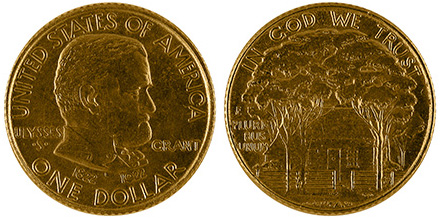
The Grant Memorial Gold Dollar was issued in 1922 for the 100th anniversary of General Ulysses S. Grant’s birth. This .90 fine-gold commemorative has Grant’s profile on its obverse and a log-cabin view of his birthplace on the reverse.
Laura Gardin Fraser designed it, including the notable inscriptions “Ulysses S. Grant” and “1822-1922.” Production took place at the Philadelphia Mint.
Other Gold Coins from the United States
Not every gold-colored coin bearing a U.S. president has gold content, but many other coins do contain gold. When this article was published, readers considering gold coins for an investment portfolio were encouraged to consider bullion coins. American Gold Eagles were offered in one-ounce, one-half-ounce, one-quarter-ounce, and one-tenth-ounce weights. At publication, the U.S. Mint produced ample quantities of these coins.
Beyond a then-current American Eagle coin, the original article noted that buyers could obtain gold coins from other nations and earlier periods. It identified these as among the more popular gold coins:
– U.S. Gold Double Eagle
– U.S. Gold Quarter Eagle
– American Gold Buffalos
Purchasing Genuine Gold Coins at Publication
When this article was originally published, Atlanta Gold & Coin Buyers stated that it could assist people seeking gold coins featuring Lady Liberty or designs by Augustus Saint-Gaudens. The business reported buying and selling collectible and bullion gold coins for customers in Atlanta and across the country.
When this article was originally published, Atlanta Gold & Coin Buyers said customers could expect a fair appraisal and transparent pricing when they sell us your gold coins. It also described its prices as among the industry’s most reasonable and invited readers at that time to contact it for information on identifying U.S. gold coins and pursuing buying or selling goals.