
What to Understand Before Selling Silver Dollar Coins
U.S. silver dollars remain among the hobby’s most recognizable and collectible coins. They appeal to both investors and collectors because, at publication, there was a price range for almost anyone interested in collecting, investing in, or selling silver dollars.
At first glance, silver dollars can seem quite similar, but important differences separate them.
Numerous considerations determine a silver dollar’s value, so understanding them before before making an investment or selling your dollar coins is important. This article examines the kinds of 90% silver dollars issued by the U.S. Mint and four major factors affecting silver-dollar prices.
Different Kinds of Silver Dollars
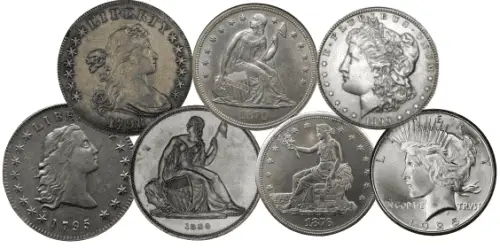
Before proceeding, it helps to define silver dollars. Here, the term means 90% silver coins the U.S. Mint issued for general circulation. The Mint made silver dollars containing 90% silver through 1935.
The best-known and most frequently traded dollar coins are Morgan dollars, minted from 1878 – 1904 and again in 1921, and Peace dollars, minted from 1921 – 1935. The 1921 Peace dollar stands apart because it was produced only in high relief and in limited quantities. When this article was published, the U.S. Mint had recently produced 2021 Morgan and Peace dollars to mark the 100 year anniversary of that transition.
Trade dollars, Seated Liberty dollars, Draped Bust dollars, and Flowing Hair silver dollars were produced before the Morgan dollar. Because of several factors addressed below, they generally traded at higher levels.
What Gives a Silver Dollar Value?
A silver dollar’s age may appear to be the chief consideration for determining its worth, but that is not always true. Often, the mintage number matters more. Although most Morgan and Peace dollars have high mintages, they traded above silver bullion coins or their silver-ounce value. Many could sell for a meaningful premium beyond the metal contained in the coin.
Among the more valuable Morgan dollars are the 1893-S, 1889-CC, 1895-S, 1895-O, and 1893-CC, but the leading Morgan issue is the 1895-P. The 1895-P Morgan was issued only as a proof and had a very small mintage of fewer than 1,000 coins. At publication, these coins sold for tens of thousands of dollars or more.
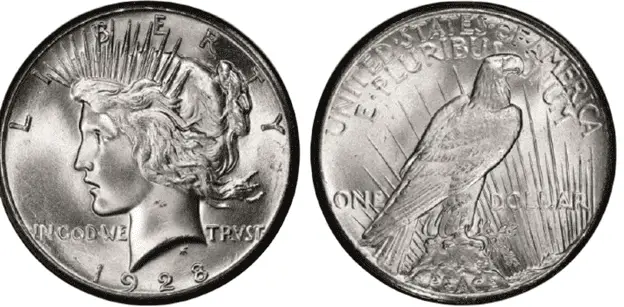
Peace dollars that traded at premiums in circulated condition included the 1921-P and 1928-P. In high-end condition, they could be worth hundreds of dollars, so the original article advised owners to develop a general sense of value before selling silver coins.
Survivorship is another consideration that can affect value when silver dollars are sold. Many dollars began as high-mintage issues, yet some were melted down in bulk to create new dollars in later years, leaving fewer coins in circulation.
The 1889-CC Morgan dollar illustrates a coin whose value reflects survivorship. The U.S. Mint produced 350,000 of them, but hundreds of thousands were estimated to have been melted, leaving a comparatively scarce coin.
Watch for Wear and Damage
As noted above, condition also affects a silver dollar’s sale price. Even high-mintage Morgan and Peace dollars can command a premium in uncirculated condition. In addition, certain
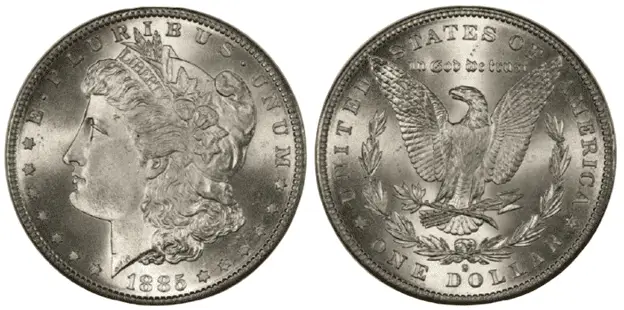 common dollars can be hard to locate uncirculated because of poor strikes from the mint in a specific year.
For instance, the 1884-S, 1883-S, and 1885-S Morgan dollars struck at San Francisco are known for weak strikes. Each was made in quantities of 1.5 million coins or more, making them common-date coins by mintage. Yet uncirculated examples are difficult to locate and, at publication, sold for hundreds or even thousands of dollars.
Because an uncirculated example can bring much more than a circulated one, auction-site sellers frequently advertised these coins as uncirculated. Based on Atlanta Gold & Coin Buyers’ experience at publication, however, very few raw or ungraded examples were actually uncirculated.
Given the substantial difference in values, the original article recommended purchasing these coins only when certified by professional grading services such as NGC or PCGS. It also suggested looking for an “MS” grade, meaning “mint state.”
How Old Is This Coin?
Although total mintage often has greater influence, a coin’s age can affect its worth as well. Collectors may also pay a premium for coins with historical significance.
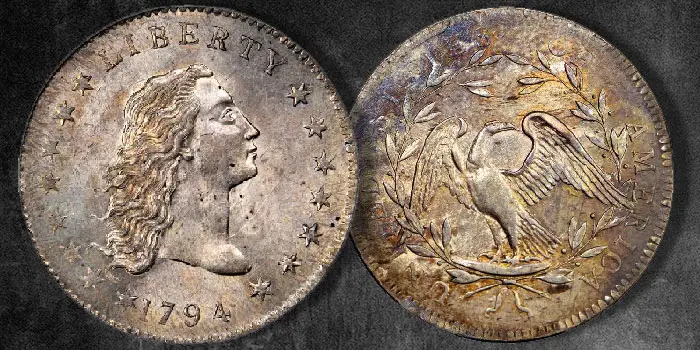
The Flowing Hair silver dollar is one example: it was the first dollar coin struck in the United States. Even in relatively poor condition, these coins were typically more valuable because collectors sought this distinctive piece of American history. The article also noted a rumor that silver from George Washington’s silverware collection was used for some of the earliest dollars made in the United States.
After becoming familiar with their coins, readers were encouraged to perform due diligence before selecting a coin dealer. The article indicated that finding a local dealer with whom an owner could build a relationship was often the best option.
At publication, Atlanta Gold & Coin Buyers reported membership in industry organizations including the American Numismatic Association, Certified Coin Exchange, CoinNet, and Roundtable Trading. It also reported being an authorized PCGS and NGC dealer.
At publication, Atlanta Gold & Coin Buyers described itself as the leading Atlanta-area coin dealer and stated that it was pleased to buy and sell silver coins, gold coins, rare coins, and more. The article said sellers could receive more for coin collections through Atlanta Gold & Coin. Readers were invited at the time to schedule with staff by calling 404-997-2918 or completing our online form.

