The American Gold Eagle Has More Behind It Than First Appears
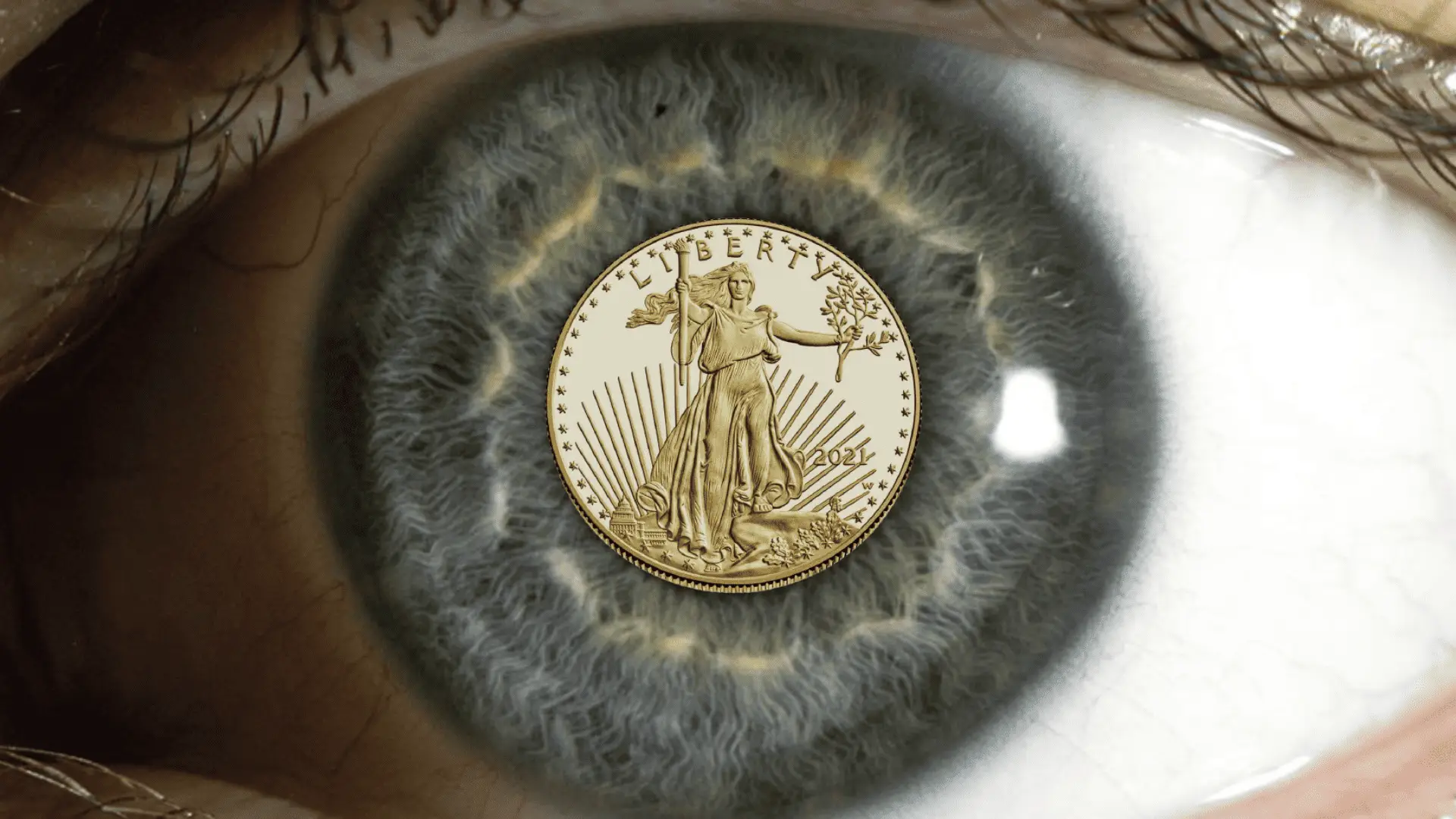
Many people looking at an American Gold Eagle notice its artwork, broad recognition, and 35-year history. Beyond seeing it as a U.S.-minted one-ounce gold bullion coin, though, they may not have considered several details that distinguish this particular coin.
This article was intended to review coin details readers might not know, or may have forgotten over time. With that introduction, the original article set out several distinctive characteristics and facts about what it described as the United States’ most popular gold coin.
American Eagle gold coins do not all share the identical appearance.
Since its introduction, the American Gold Eagle’s design has been revised.
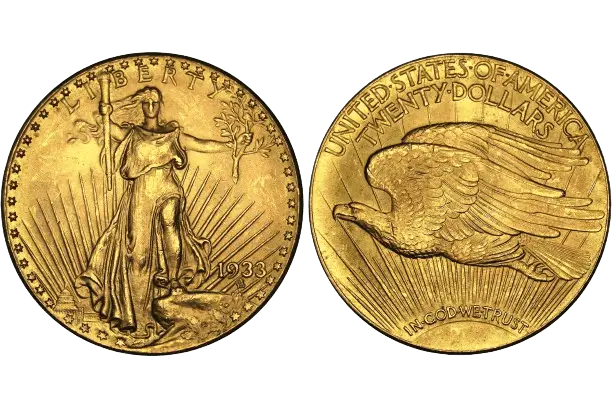
The obverse has consistently displayed Augustus Saint-Gaudens’ Lady Liberty artwork. Often regarded as among America’s finest coin designs, it was originally created for the Double Eagle series minted from 1907 through 1933.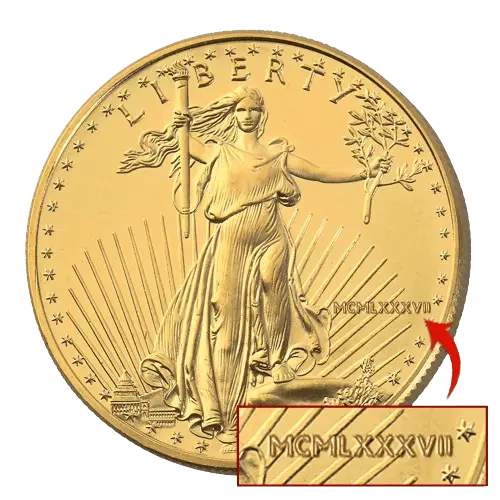
The coin’s front, or obverse, changed very little, with one small exception. Dates struck from 1986 through 1991 used Roman numerals. Beginning in 1992, Arabic numerals replaced them. Under both approaches, the obverse carries a mint mark beneath the date.
The reverse experienced a far more significant revision in mid-2021. Between 1986 and 2021, it showed Miley Busiek’s scene of an eagle holding an olive branch and seemingly returning to a nest occupied by another adult eagle and young. In 2021, that artwork gave way to Jennie Norris’s eagle side-profile design.
At the time of original publication, the article described the following: The former reverse is commonly called a “Type 1” gold eagle, while the replacement is called a “Type 2” gold eagle. At publication, the article reported comparable demand and pricing for both Gold Eagle types.
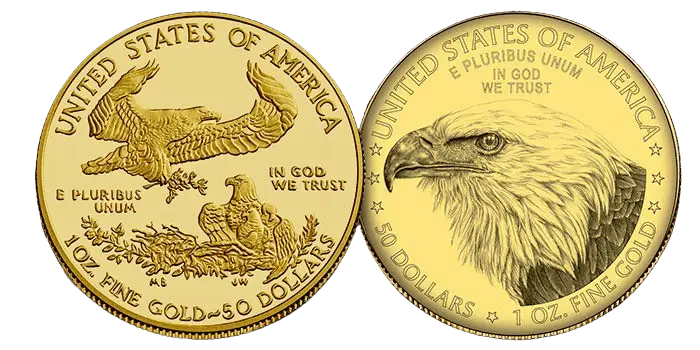
Gold coins from two separate U.S. eras both carry the name eagle.
When a person says they own a gold eagle coin, the useful follow-up question is, “which kind?”
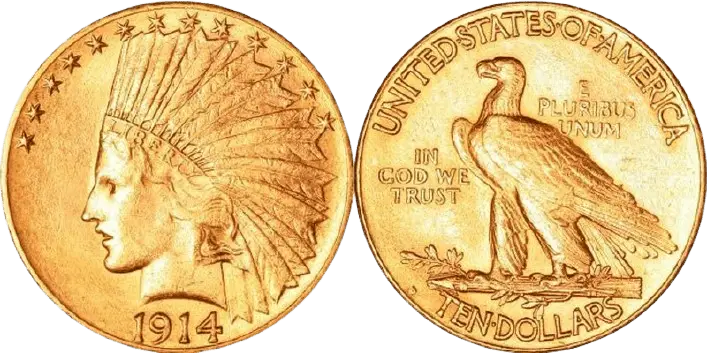
At the time of original publication, the article described the following: Besides the Saint-Gaudens Double Eagle already discussed, another Eagle gold coin existed before the modern program. The first American gold coins, issued in 1795, were $10 pieces, known as “eagles.”
Every U.S. $10 gold coin issued through 1933 is categorized as an eagle coin. Their age often gives them collector interest, particularly when they are in high-end condition. When this article was originally written, it noted that the $10 Indian Head gold coin was especially popular.
The later Eagles, struck beginning in 1986, are also American Gold Eagles, although informed sellers often identify them more precisely by weight. This avoids confusion because the modern series comes in multiple sizes: 1 oz, 1/2 oz, 1/4 oz, and 1/10 oz. Thus, an answer of “It’s a 1 oz Gold Eagle or $50 gold coin,” identifies the newer coin.
American Gold Eagle bullion coins cannot be ordered directly from the Mint.
The American Gold Eagle and American Gold Buffalo are official U.S. gold bullion coins. The United States Mint, however, does not sell bullion coins straight to the public. Unless a buyer was an authorized precious-metals dealer, the Mint would not sell that buyer a brilliant uncirculated American Gold Eagle bullion coin.
Although authorized dealers purchase American Gold Eagle bullion coins, the public can buy certain Gold Eagle varieties directly. The exception includes selected versions such as burnished and proof American Gold Eagle coins.
Gold Eagle coins carry legal-tender status.
In technical terms, a $50 face-value 1 oz Gold American Eagle could be used for a $50 purchase of goods or services. Other denominations were the $25 eagle (1/2 oz), $10 eagle (1/4 oz), and $5 gold (1/10 oz).
American Gold Eagles are legal tender and, as the original article stated, must legally be accepted for debts. It nevertheless advised against spending one at face value because its intrinsic value is much greater, even in a serious emergency. At publication, it suggested that, in a worst-case situation, a pawn shop could buy one for at least 50% of gold’s spot price.
An American Gold Eagle’s meaningful value extends well beyond its face value. This 22-karat gold coin contains one troy ounce of fine gold. Its composition is 91.67% gold, with silver and copper included to complete its weight and improve durability.
Its gold content makes the coin worth many times its stated face value. At the time of publication, the article reported that, in recent years, spot gold had remained at over $1,000 per troy ounce. It also reported an estimated gold-mining cost in the $1,000 range, which it characterized as providing something of a floor.
Gold Eagles have been made at only one Mint

American Silver Eagles have come from several facilities, including Philadelphia, San Francisco, and West Point. American Gold Eagles, by contrast, are produced solely at West Point. That statement includes regular bullion issues as well as burnished and proof examples.
That arrangement differs from many other U.S. coin issues, historically made at the Philadelphia, Denver, and San Francisco Mints.
Beyond those facilities, U.S. gold coins were made at several mints that no longer operate: New Orleans, Carson City, Charlotte, and Dahlonega. New Orleans and Carson City struck gold coins across all denominations. Charlotte and Dahlonega, in contrast, produced only $2.50 and $5 Liberty Head gold coins.
The Gold Eagle Comes in Multiple Varieties
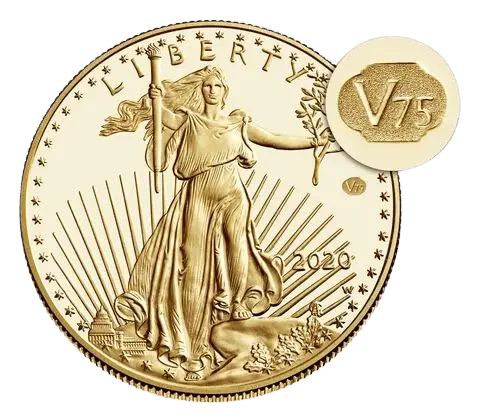
As noted earlier, the American Gold Eagle includes several varieties or types. The article had already mentioned proof and bullion examples, both produced in consecutive years since their introduction in 1986.
Alongside proof and bullion American Gold Eagles, the burnished Gold Eagle debuted in 2006. It was produced in consecutive years except 2009 and 2010. These coins have a matte-like surface and come with a box and certificate of authenticity. At publication, their prices were described as comparable to bullion Gold Eagles.
Two additional proof Gold Eagle versions have been struck: a reverse proof in 2006 and a World War II 75th-anniversary proof Gold Eagle featuring a “75” privy
mark. Production totaled only 1,945 coins, and when this article was published, examples were selling above $10,000 when certified in a 70 grade.
The American Gold Eagle has faced more counterfeiting than other bullion gold coins.
Consider the choice facing a counterfeiter planning to imitate a gold coin. A coin with exceptional popularity and strong name recognition would likely be the natural target.
The Gold American Eagle fits that description. Investors and collectors worldwide have favored these coins, and the original article said they had been leading sellers since their introduction in 1986.
Given their value and popularity, the article said it was unsurprising that 41.2% of coin dealers in the United States had encountered customers seeking to sell counterfeit Gold American Eagles. Many prospective sellers may genuinely believe a coin is authentic. They may have bought online from an unreliable dealer, through eBay, Craigslist, Facebook, or a flea market, believing they received a deal far below market value without recognizing the problem.
Others may know a coin is not genuine and approach dealers while attempting a substantial sale. A coin dealer with appropriate knowledge, however, should not mistake a replica or counterfeit Gold Eagle for an authentic coin.
The article explained that many reputable coin dealers had completed counterfeit-detection training, used electronic testers, and had other verification tools available. If uncertainty remained, a dealer could submit the coin to an independent grading service to resolve the authenticity question.
Investing in Gold American Eagles
The Gold American Eagle is widely admired for its appearance and valued for its precious-metal content. The original article presented adding these coins to physical holdings or a precious-metals IRA as a way to build and diversify an investment portfolio. At publication, readers were invited to review its page for other gold coin prices.
When this article was originally published, Atlanta Gold & Coin Buyers stated that it provided fair, competitive prices and explained how it reached coin valuations. It also described transparent pricing and attentive customer service. Readers with Eagle questions were invited to seek the help you get the answers they needed. Atlanta Gold & Coin described itself as dedicated to customer satisfaction and service.