


 Hunter Rhodes
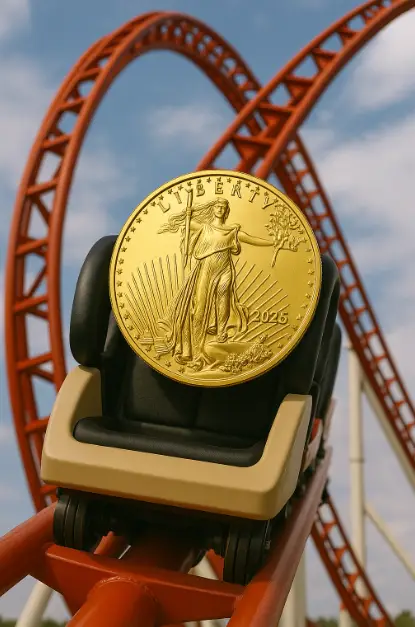
A collectible gold coin can respond to more than the gold price, but that does not automatically make it less risky than bullion. Its value also depends on rarity, condition and demand from collectors. Adding a numismatic premium changes the sources of risk rather than guaranteeing a smoother return.
Before using collectible coins to address volatility, separate three questions: how strongly the item follows spot, how reliably its value can be observed and how easily it could be sold. A price that is updated infrequently can look stable even when the next executable bid is uncertain.
Modern collectible gold
Proofs, commemoratives and limited editions can sell for more than their fine-gold value. Their appeal may involve design, finish, packaging or a particular collecting series. A low mintage is useful context, but demand and surviving availability determine whether buyers support the premium.
Some issues have stronger markets in their country of origin or among specialist collectors. That is a reason to identify possible resale outlets before buying, not a rule that all foreign coins are inferior to U.S. coins.
A product's premium can contract as gold rises, or decline when collectors move to another issue. Ask for both a retail quote and a current buying indication for the exact version you are considering. Keep proof, bullion and graded examples separate in the comparison.
Common historic gold with a modest premium
“Semi-numismatic” is a market description for coins whose prices reflect both metal and some collecting interest. Common-date pre-1933 U.S. gold is often discussed this way. The label does not establish a fixed premium, a guaranteed return or protection from future legal changes.
Verify fine-gold content for the denomination. A historic $20 gold piece is not identical in gold content to a modern one-fine-ounce bullion coin. Compare complete prices on a consistent basis before deciding that one is cheaper.
The historical 1933 restrictions included exceptions, but they should not be turned into a promise that every pre-1933 coin would be exempt from any future law. A hypothetical future policy would have its own language and scope.
Scarce dates and high-grade coins
A scarce date, variety or unusually well-preserved example may derive much of its value from collector demand. Its price can therefore move differently from bullion. It also requires more specialized research and may have fewer closely comparable transactions.
A grade of 65 or 66 is not a universal investment sweet spot. The significance of that grade depends on the series, available population, eye appeal and price. Some common issues are plentiful at a grade that is exceptional for another issue.
Certification provides information about the graded coin, but it does not guarantee that the purchase price is reasonable. Verify the holder and certification details, examine the coin and compare relevant completed sales. A record price for a spectacular rarity does not establish returns for an ordinary collection.
Measure liquidity as well as apparent stability
A widely traded bullion product may have frequent bids, while a specialist collectible may require an auction or a longer search for a buyer. Commissions, shipping and settlement delays can affect the result. Ask what a prompt sale would realistically involve.
Do not assume that the absence of a changing screen price means the value is unchanged. Infrequent transactions can conceal uncertainty. To claim lower volatility or correlation, an analysis would need representative transaction data, consistent dates and an allowance for selling costs.
Choose a budget that does not depend on a forecast
If you enjoy numismatics, a carefully researched collectible can be worthwhile as part of that interest. Set the budget in light of your finances and willingness to hold an item whose next selling price is uncertain. There is no universal 10% allocation suitable for every owner.
Money needed for near-term expenses should not depend on finding a specialist collector at a favorable moment. Central banks' reserve decisions also should not be copied without considering their very different obligations and holding periods.
Atlanta Gold & Coin Buyers can help compare particular historic and modern products, their metal content and current resale terms. The goal is to understand the tradeoff you are making, rather than assume a collectible premium removes market risk.

About the author
Hunter Rhodes
Owner & Managing Director, Atlanta Gold & Coin
Hunter joined Atlanta Gold & Coin in 2022 and purchased the company at the end of 2024. He has been investing in precious metals since 2010, with gold remaining his favorite metal. While he may never admit it, Hunter has a numismatic collector’s side, especially when it comes to select type coins. Libertads and Engelhard rounds are among his favorites.
Meet our team