


 Hunter Rhodes
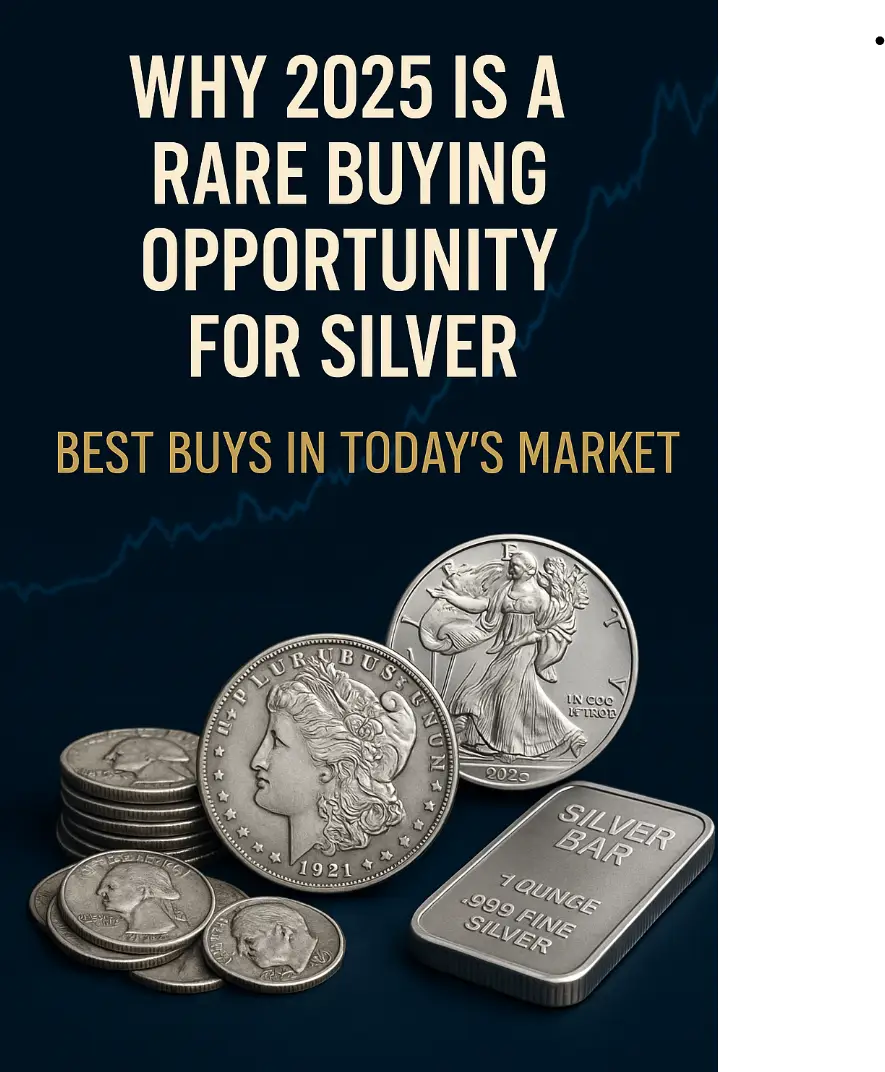
A low premium can make physical silver less expensive relative to its metal content. It does not necessarily make the total purchase price low, and it does not guarantee that premiums or spot prices will rise afterward. Both parts of the price deserve attention.
This article originally discussed offers and market impressions from July 2025. Its old premium ranges should not be treated as current inventory quotes or statistically established historical averages. The following comparison explains how to evaluate the same product categories using current terms.
90% silver: convert face value carefully
For common circulated U.S. 90% silver dimes, quarters and halves, a frequently used convention is .715 fine troy ounce per $1 face value. Under that convention, $1,000 face represents approximately 715 fine ounces. Heavily worn coins may require an actual-weight assessment.
At a hypothetical spot reference of $37, 715 ounces have a metal-reference value of $26,455. A 5% premium would produce $27,777.75 before other charges. A $29,000 price would instead be about 9.6% above that reference, not 3–5%.
These figures illustrate the arithmetic. Verify the actual quantity, wear allowance and complete quote before comparing offers. Face value, metal value and sale proceeds are three different amounts.
Morgan and Peace dollars: allow for a different silver weight
Standard historic Morgan and Peace dollars contain approximately .7734 fine troy ounce at full nominal weight. They should not be counted as one-ounce silver coins or included in the dime-quarter-half convention without a separate calculation.
Common circulated examples may be valued largely for silver plus a product premium. Scarce dates, varieties and higher grades can require individual treatment. A low apparent premium is not a reason to skip authentication or overlook a collectible coin in a group.
Foreign silver: identify the exact issue
Older world coins can have different weights and finenesses within the same country or denomination. Verify the date and specification rather than assuming a bag is uniformly silver or uniformly pure.
Modern government bullion coins often provide a simpler fine-weight comparison, but their premiums and resale bids still differ. A familiar issuer may have a broader local market than an unusual historic issue; the actual quote should establish the tradeoff.
A world coin near melt can still be expensive to authenticate, handle or resell relative to another option. Compare the full transaction, not only the percentage above a calculated metal value.
Silver Eagles: measure the premium that buyers recognize
American Silver Eagles contain one fine troy ounce of silver and have a distinct retail market. Their purchase premium can vary with availability, date, condition and demand. A high level of recognition does not guarantee recovery of every dollar of premium.
Request a current buying indication alongside the selling quote. Keep ordinary bullion coins separate from proofs, special issues and graded examples so the comparison concerns the product actually offered.
Bars and rounds: compare unit size and selling flexibility
Generic products may offer economical metal exposure, while a particular maker or collectible design can add a premium. Larger bars can reduce some acquisition costs but make partial sales less flexible. Smaller pieces may cost more per ounce to fabricate and handle.
Check authentication procedures and future selling requirements. Previously owned bullion is not automatically inferior, but its actual condition and recognizability can affect the bid.
Put spot and premiums into one decision
A falling spot price can coincide with a higher premium, but it does not always do so. Likewise, a low premium may stay low or decline further. There is no dependable rule that waiting must cost more.
Compare the total dollars required, current resale spread, storage needs and your available budget. A forecast that silver will catch up with gold should not substitute for those checks.
Contact Atlanta Gold & Coin Buyers for current prices on the specific quantities and products you are considering. A well-supported comparison can identify value without relying on an expired promotion or an urgent prediction.

About the author
Hunter Rhodes
Owner & Managing Director, Atlanta Gold & Coin
Hunter joined Atlanta Gold & Coin in 2022 and purchased the company at the end of 2024. He has been investing in precious metals since 2010, with gold remaining his favorite metal. While he may never admit it, Hunter has a numismatic collector’s side, especially when it comes to select type coins. Libertads and Engelhard rounds are among his favorites.
Meet our team