



 Hunter Rhodes
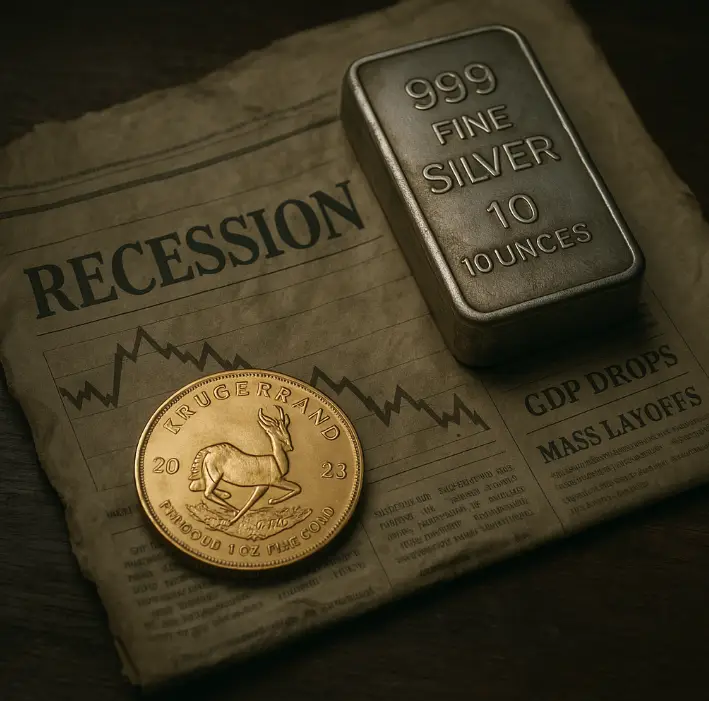
Gold and silver can behave differently from stocks during economic stress, but neither metal is guaranteed to rise in every recession or market decline. The result depends on the period measured, the pricing benchmark and the costs of the actual investment.
A useful comparison starts with consistent dates. Mixing a stock index's worst drawdown with a metal's gain across a longer interval can create a misleading picture of protection.
Define the recession before calculating returns
The National Bureau of Economic Research's chronology identifies U.S. business-cycle peaks and troughs. A recession is not determined solely by two consecutive declines in quarterly GDP. The committee evaluates a broader contraction in economic activity.
For the period from 1971 through 2020, the chronology includes the following peak-to-trough pairs. These are dating reference points, not metal or stock return calculations.
| Business-cycle peak | Business-cycle trough |
|---|---|
| November 1973 | March 1975 |
| January 1980 | July 1980 |
| July 1981 | November 1982 |
| July 1990 | March 1991 |
| March 2001 | November 2001 |
| December 2007 | June 2009 |
| February 2020 | April 2020 |
The 1980 and 1981–1982 contractions were separate recessions. The 2020 downturn was also an official recession, so it is incorrect to describe a subsequent downturn as the first since 2008–2009.
Use the same measurement choices for each asset
Choose the same observation dates, currency and frequency for gold, silver and stocks. State whether stock returns include dividends. Decide whether prices are month-end observations or monthly averages, and apply that choice consistently.
Nominal returns differ from inflation-adjusted returns. A positive dollar gain can still represent a loss of purchasing power. Taxes, commissions, storage and insurance affect the outcome for an individual holder.
The percentage change is ending value divided by starting value, minus one. A maximum drawdown is a different measure: it describes the decline from a peak to a later low within the period. Both can be useful, but they should not be presented as interchangeable returns.
Keep the source data and calculation available when publishing a return comparison. A reader should be able to reproduce the figures, see the observation dates and understand which expenses were excluded.
Why gold may respond differently from stocks
Gold demand can rise when investors seek defensive assets or expect lower real interest rates. It has no corporate earnings stream, so its price drivers differ from a company's share price. That difference can be relevant to diversification.
It does not establish a constant negative correlation. Gold can be sold to raise cash during stress, and currency or interest-rate movements can offset defensive demand. A physical coin retains its metal content while its market value can still decline.
A rate cut is not identical to quantitative easing. Monetary responses differ across recessions, and their effect depends partly on what markets already expected. Avoid treating a policy response as a mechanical guarantee of higher metal prices.
Silver adds industrial exposure
Silver serves investment and industrial uses. A slowdown can reduce some industrial demand even if investors want more physical metal. This helps explain why silver should be evaluated separately from gold rather than described simply as the same hedge with greater upside.
Product premiums can also move independently of spot. A shortage of a particular coin may raise its retail price while another product remains available at a lower premium. An owner selling during that period needs an actual bid, not just a headline about retail scarcity.
Build a practical plan without a recession deadline
A stock-market decline can occur without a recession, and a recession can be recognized only after it has begun. Trying to organize household finances around the exact announcement date creates unnecessary dependence on a forecast.
Keep funds for near-term needs accessible and choose any metals allocation in the context of your overall finances. If selling would be required during an emergency, consider the spread and payment timing as well as the metal's past performance.
The original July 2025 article included unsourced return comparisons and forecasts. Those figures have been replaced with a transparent framework and the official historical dates. Atlanta Gold & Coin Buyers can explain current physical-product terms so a purchase or sale is based on verifiable information rather than a claim of guaranteed recession protection.

About the author
Hunter Rhodes
Owner & Managing Director, Atlanta Gold & Coin
Hunter joined Atlanta Gold & Coin in 2022 and purchased the company at the end of 2024. He has been investing in precious metals since 2010, with gold remaining his favorite metal. While he may never admit it, Hunter has a numismatic collector’s side, especially when it comes to select type coins. Libertads and Engelhard rounds are among his favorites.
Meet our team