
Silver Half Dollars: Which Ones Are Worth Investing In?
At some point, many people have likely carried a Kennedy half dollar in a pocket. When this article was originally published, these coins could still occasionally turn up in circulation. The important distinction was between Kennedy half dollars seen then and those that entered circulation more than 100 years earlier.
Barber, Walking Liberty, and Franklin half dollars are familiar designs within the well-known 90% half-dollar series that appeared in American coinage over time. What made these coins especially popular? Collectors and investors often included these silver half dollars in collections or investment portfolios because United States Mint issues dated 1964 and earlier contained 90% silver. Following the Coinage Act of 1965, half-dollar composition was reduced from 90% silver to 40% silver.
In 1971, half dollars changed composition again as the United States began striking pieces made with 75% copper and 25% nickel, eliminating their remaining silver content. At the time of publication, half dollars made for general circulation continued to use copper and nickel.
Although the U.S. Mint no longer produced 90% silver half dollars, many examples remained and were actively sought by coin buyers. At the time of publication, 90% silver halves ranked among the market’s more popular silver-coin investment choices.
A coin’s condition, rarity, date, and mint of origin can each materially affect both its value and how readily it trades. This article identified half dollars that could bring substantial premiums and those that sold chiefly for intrinsic silver content, helping readers make more informed choices when buying and selling silver half dollars at that time.
Bust Silver Half Dollars: 1794 – 1839
Bust half dollars hold an important place in American history because they were among the earliest coins made by the U.S. Mint. The Bust half-dollar series included three successive design types—Flowing Hair, Draped Bust, and Capped Bust—minted between 1794 and 1839.
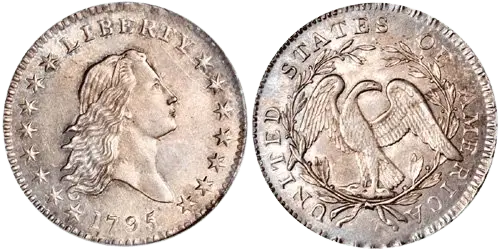
Flowing Hair U.S. half dollars were the first of the three design styles, struck only briefly from 1794–1795. They were followed by Draped Bust half dollars, dated 1796–1807, and finally Capped Bust half dollars, dated 1807–1839.
At the time of original publication, the article described the following: It is understandable that Flowing Hair half dollars, the lowest-mintage type and a design struck for only two years, commanded the strongest values. These coins could sell for thousands of dollars, although locating high-grade examples could be especially difficult because of their age and limited availability. Even so, they remained collector favorites.
At the time of original publication, the article described the following: Two years after the Flowing Hair half dollar entered circulation, the first U.S.-minted half dollar received the redesign known as the Draped Bust half dollar. Robert Scot, the U.S. Mint’s first Chief Engraver, created the design using portraitist Gilbert Stuart’s portrayal of Liberty as inspiration. Two Draped Bust half-dollar reverse designs exist, and one carries substantially greater value than the other.
The details of Bust half dollars could fill an entire article. In short, among the two reverse designs, the version bearing a small eagle is regarded as one of American numismatics’ rarest silver types. That design had an exceptionally small mintage and was made for just two years, 1796 – 1797, with reported values ranging from $10,000 – $125,000!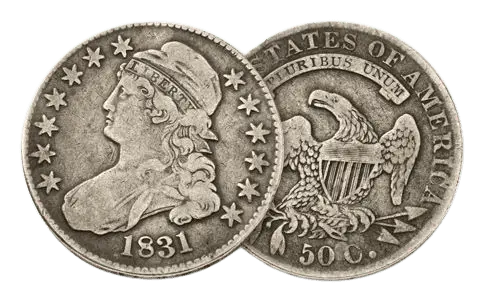
After the rarest Bust half dollar, the Capped Bust half dollar was presented as the more attainable option for collectors. In circulated condition, values could range from $50 – $200 or higher. Prices generally rose around the almost uncirculated, or AU, grade, while certified uncirculated pieces traded above $1,000.
For someone considering a certified Bust half dollar for a collection, several factors could affect both the purchase price and the amount ultimately received upon selling. Those considerations apply broadly to coins and were useful points to keep in mind.
Date and Mintmark
For any coin collection, date and mintmark are important considerations. Individual mints struck differing quantities, and yearly output also varied. For instance, 300,000 Flowing Hair Bust half dollars were minted, compared with only 3,918 Draped Bust half dollars with the small-eagle reverse.
Grade
Condition is crucial for these coins, and a difference of a single grade tier can mean thousands of dollars gained or lost. For readers who were considering a valuable Bust half dollar at the time of publication, Atlanta Gold & Coin recommended concentrating on coins certified by leading third-party grading service (TPGS) companies such as NGC or PCGS. Their grading was generally viewed as more consistent, and they were accepted as industry standards.
Seated Liberty Half Dollars: 1839 – 1891

The Seated Liberty half dollar followed the Capped Bust half dollar and preceded the Barber half dollar, spanning 1839 through 1891. Its design depicts Lady Liberty seated on a rock, wearing a flowing dress, with a shield in her right hand and a liberty pole topped by a Phrygian cap in her left. The series includes several varieties, including coins with drapery, arrows and rays, and without them.
Although generally less valuable than Capped Bust half dollars, circulated Seated Liberty examples typically ranged from $25 – $100. They could reach hundreds of dollars when they had low mintages or were certified uncirculated. As noted earlier, coins certified by NGC or PCGS were generally the most popular with collectors and tended to have the strongest resale.
Regarding stronger resale results, the reported highest price realized for a Seated Liberty half dollar was $517,000 for an 1853-o half dollar without arrows or rays. Just four examples are known. These pieces rarely appeared on the market; the original article reported that the most recent one had sold at auction in 2017.
Barber Silver Half Dollars: 1892 – 1915
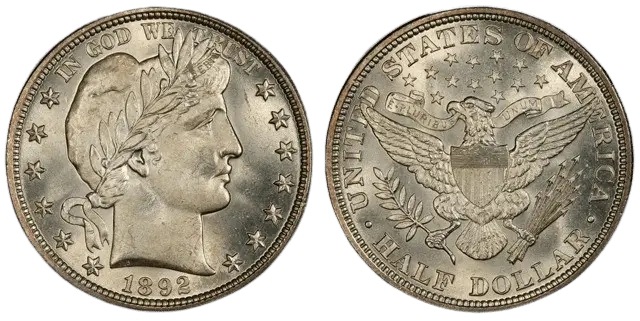
Barber half dollars were created by Charles E. Barber and struck from 1892–1915. Most Barber half dollars had relatively high production totals and were found in noticeably worn condition. Although these coins circulated for many years, certain key-date and lower-mintage issues existed and could sell for meaningful premiums.
Notably, most half dollars dated 1897 and earlier had lower production numbers, along with the 1904-S, 1913-P, 1914-P, and 1915-P half dollars. Excluding proof coins, the Barber half dollar described as most valuable was an 1892-o. The micro variety “O,” identified by its smaller mint mark, sold at a higher price than the standard-size “O.”
At the time of original publication, the article described the following: As noted earlier, heavy circulation affected most Barber half dollars. Consequently, even common-date examples in stronger condition—Very Fine or better, for example—could still bring a premium.
Walking Liberty Silver Half Dollars: 1916 – 1947
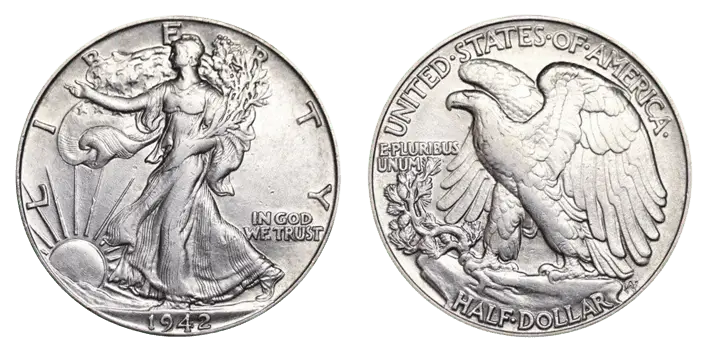
The U.S. Mint struck Walking Liberty half dollars from 1916 through 1947. Adolph Weinman designed these coins, and their image became sufficiently popular to be revived on modern-issued 1 oz American silver eagles. Most Walking Liberty half dollars were common-date issues, but a small group could be quite valuable, particularly in high-grade or certified condition.
Among the most popular and sought-after Walking Liberty half-dollar dates were issues from 1916, 1919, and 1921. In particular, the 1921-P and 1921-D typically traded at the highest values. Limited-production examples were considered rare or scarce dates and could sell for hundreds of dollars or more in high-end condition. These dates and values were exceptions rather than the normal result.
Putting together a complete set of circulated Walking Liberty coins was relatively manageable and could be accomplished on a modest budget. The iconic Walking Liberty image, which inspired the American silver eagle, together with the series’ popularity, was presented as making these coins a potentially appealing long-term investment.
Franklin Silver Half Dollars: 1948-1963
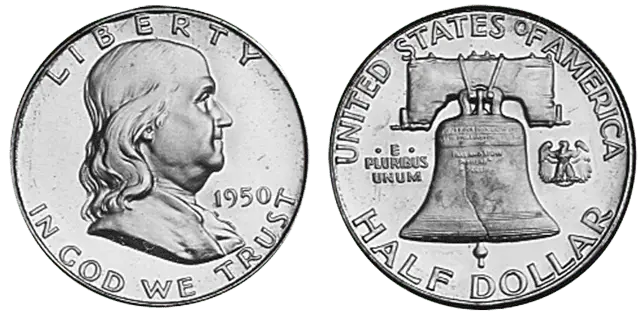
Franklin half dollars, designed by John Sinnock with assistance from Gilroy Roberts, show a profile of Benjamin Franklin on the obverse and the Liberty Bell on the reverse. They were struck from 1948 to 1963, making the series one of the shorter coin runs. Nevertheless, many coins were produced during that comparatively brief period.
A total of 460 million coins were produced during that 16-year span, an average of nearly 29 million coins annually. Given the large mintage, these coins were quite common, and examples with average circulation or moderate wear sold for their underlying silver value.
These coins are often described with the term “junk silver“, but every example made before 1965 is a 90% silver coin. For Franklin half dollars, that means there is no need to inspect the date to decide whether the coin contains silver. Another useful guideline for comparing 90% silver half dollars with one ounce of silver is remember that roughly 3 silver half dollars is about one troy ounce.
In addition to bullion content, certain Benjamin Franklin half dollars may carry collector value. This is especially true of proof coins issued from 1950 – 1953, along with a small number of dates in exceptional condition, including the 1949-S and 1952-S. Collectors may therefore sell certain coins at a higher price.
At the time of original publication, the article described the following: 1964 Kennedy Silver Half Dollars: (current at publication)
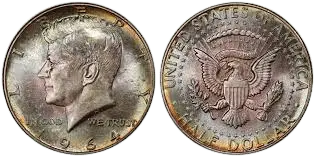
After President John F. Kennedy was assassinated on November 22, 1963, Congress moved quickly to approve production of the Kennedy half dollar. Gilroy Roberts designed the coin, placing a profile portrait of President Kennedy on the front, or obverse. The reverse carries a heraldic eagle holding an olive branch.
The 1964 Kennedy silver half dollars are widely encountered. The Philadelphia and Denver mints produced 433 million coins, and their value generally follows silver’s spot price according to their actual silver weight of .3616. It is important to recognize that only John F. Kennedy 1964 half dollars contain 90% silver. When this article was originally published, readers considering a purchase or sale were advised to check dates carefully so silver coins would not be confused with nickel-copper pieces.
A further well-known variety is the 1964 proof Kennedy half dollar made by the Philadelphia Mint. These coins were included in proof sets, with a total production of 3.95 million. Two versions of the 1964 proof Kennedy half dollar exist. The more common standard variety uses the same obverse as the regular, or business-strike, half dollar. The other, known as an “accented hair,” shows an extra strand of hair above the ear and is estimated to represent 1% – 3% of total mintage.
Keep in mind that 1964 marked the final year in which 90% silver half dollars entered general circulation. After the Coinage Act of 1965 reduced the coins from 90% silver to 40% silver, many were set aside by investors and collectors. Kennedy half dollars remained 40% silver through 1970.
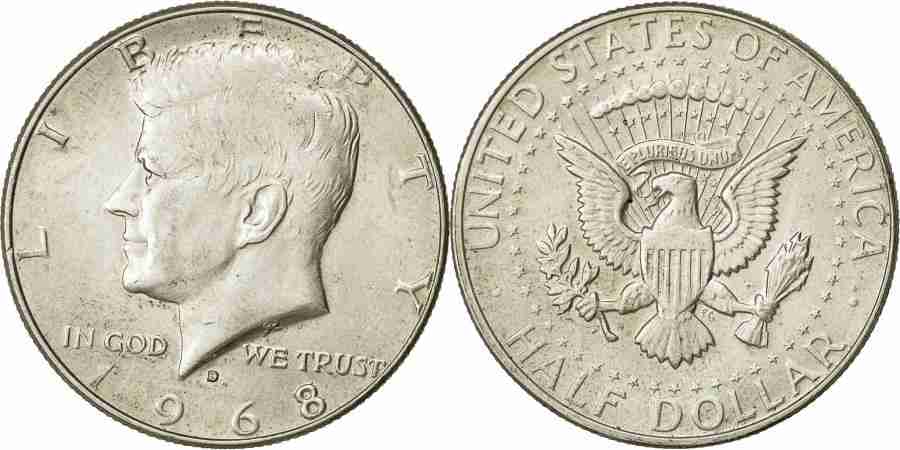
At the time of original publication, the article described the following: Because these coins circulated for only a limited period, they are often found in noticeably better condition than the half dollars discussed earlier. Even though production was high, their preservation and the silver they contain supported the article’s view that they could be worthwhile investments.
People interested in JFK may also have considered the 50th-anniversary gold and silver coins and sets the U.S. Mint produced in 2014. The four-coin silver set included pieces issued in Philadelphia and Denver, each with differing finishes. The proof gold Kennedy half dollar was offered separately and contained 3/4 of an ounce of fine gold.
Summary
When this article was originally published, readers considering an investment in or sale of silver half dollars were told that the experienced silver coin dealers at Atlanta Gold & Coin Buyers could help. At publication, readers were invited to Fill out our online form today or give us a call to arrange an appointment.

